


From whole-life carbon assessments to reclaimed steel, specialist AI tools promise to make low-carbon building easier. The danger, a London Build panel warned, is automating away the expertise the industry depends on.
Artificial intelligence could soon cut a carbon assessment that once took weeks to about an hour. That’s a tempting prospect for an industry where embodied-carbon calculations are slow and low-carbon choices often come after the design is fixed. But a panel of engineers and sustainability specialists at London Build 2026 argued that simply speeding up existing processes misses the point. The real test is whether AI helps the industry make better decisions, and whether people can still check its answers.
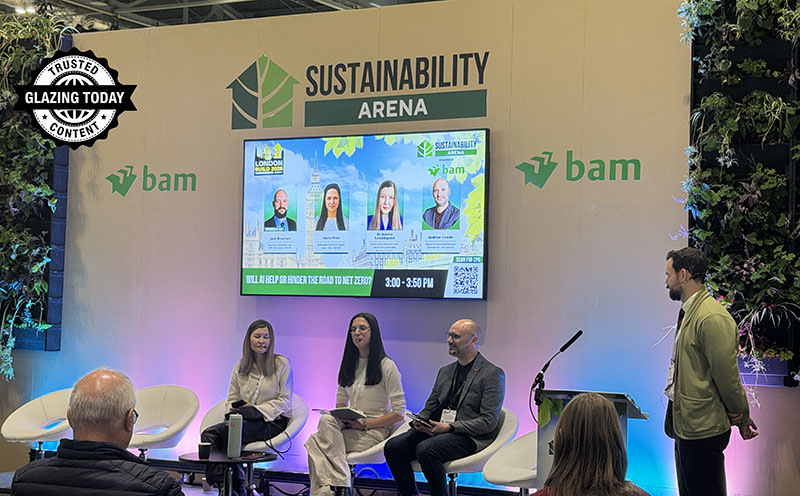
The session covered everything from automated building models to the environmental cost of data centres. The moderator Jack Brunton, Structural Lead, EUR – UK&I, AECOM, said from the outset that the focus was not general-purpose chatbots such as ChatGPT. It was tools built for specific jobs: spotting reusable materials in photographs, automating carbon data or helping design teams compare options.
Andrew Cowan, who leads One Click LCA’s UK and Ireland team, described software that builds an early-stage building model from basic dimensions and a postcode. It takes account of local planning constraints and lets users choose materials for a whole-life carbon assessment. Work that might once have taken weeks could be done in about an hour, he said, depending on the building.
Cowan said the point is to strip out administration so specialists can spend their time on more substantial checks. Faster assessments don’t remove the need for human oversight. The same goes for environmental product declarations (EPDs), which must be verified by a third party. Cowan said some manufacturers had tried using general-purpose chatbots to find product data. That is a risky shortcut in a field where accuracy and formal verification are everything.
That distinction goes to the heart of AI’s potential in construction. Used well, the technology could bring carbon analysis into decisions that have been made without it, or made too late for it to count. Used badly, it simply makes old habits more efficient.

Ioana Price, deputy lead for sustainable structures in the UK and Ireland at AECOM, argued that AI could help break down the industry’s entrenched professional silos. Teams now tend to optimise foundations, façades or building services in isolation. Digital workflows could let them weigh options across disciplines from the earliest stages of a project.
The potential gains are considerable. Price cited a study suggesting that, on average, structural elements in new buildings are only about half utilised. Better analysis could cut that excess material. It could also give teams the confidence to consider lower-carbon options such as timber, which are often ruled out early simply because of uncertainty.
Mechanical, electrical and plumbing (MEP) design is one example. Carbon assessments for these systems often arrive late, sometimes not until construction is under way. AI-assisted comparisons could let teams test different systems against cost, carbon and space requirements far earlier. The panel agreed the aim should be to do work that otherwise wouldn’t happen at all, not just to finish existing calculations faster.
Reuse is another test case. Dr Asselia Katenbayeva, sustainability research lead at the Alliance for Sustainable Building Products (ASBP), described research projects training AI models to assess reclaimed steel from smartphone photographs. A salvaged section may carry corrosion, holes or fixings from its previous life. The system could help judge whether it is fit for reuse by weighing its condition and length against likely demand.
Those judgements matter most when a building is about to be dismantled or demolished and the window to recover material is short. The moderator noted that reclaimed steel can reportedly cut upfront carbon by 95 per cent compared with a new section. If AI helps teams identify reusable material at scale, the emissions saved could dwarf the energy used to run the assessments.
Katenbayeva said one Innovate UK-funded project had compared the carbon cost of training an AI model with the potential savings from steel reuse. The model’s footprint came to less than 1 per cent of those savings. She also cited an estimate that an office worker sending 30 prompts a day to a text-based AI tool might account for about 4kg of carbon dioxide a year. She cautioned that both figures came from published sources and company reporting, and that video generation and other compute-heavy uses are a different matter.
None of this makes AI impact-free. Data centres consume electricity and materials, and building them affects biodiversity as well as emissions. Price cited research suggesting AI will be a net contributor to emissions until 2030. From 2035 onwards, it could enable reductions that outweigh its own footprint.
Whether that happens depends partly on how the infrastructure itself is designed. The panel pointed to scope for cutting data centres’ energy and water demand and for reusing their waste heat. One study cited during the discussion estimated that London’s data centres give off enough waste heat to warm half a million homes a year. Many of these facilities will be built regardless. As Price put it, the job is to make them “a little bit less bad”.
There is a subtler cost, too: the loss of learning by doing. If AI automates routine calculations, graduates may get fewer chances to make mistakes and learn from them. That experience builds the judgement needed to spot when a machine has got it wrong.
The panel offered no easy answer. Universities and employers may need to redesign training, using simulations and deliberate practice to build the skills that automation removes from everyday work. Ioana Price warned that as AI tools become commonplace, it will be people, not software, that set firms apart.
That may be the biggest caveat to the industry’s optimism. AI could help construction measure carbon earlier, use less material and recover more from existing buildings. But automation alone won’t deliver net zero. That will take professionals who know what to ask, understand what the answers mean and are prepared to challenge them.
Why This Matters: For fenestration, the message is direct. AI-driven whole-life carbon assessments will expose glazing and aluminium framing as a building’s carbon hotspots, then flag which components can be recovered rather than landfilled. TU Delft research into “façade-as-a-service” models, in which suppliers lease aluminium façades and glass to a building and reclaim them at demolition, points to the next step. AI could track that take-back loop and interrogate digital product passports. Systems houses and fabricators with verified EPD data will win specifications.