
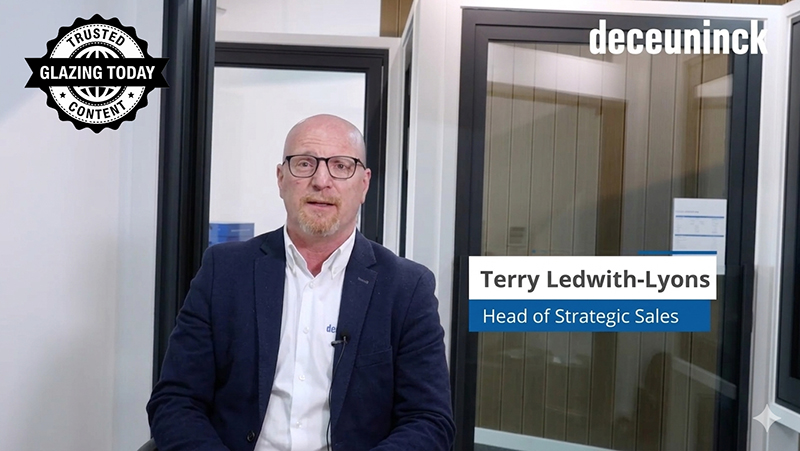

Deceuninck Aluminium is positioning itself as a premium UK systems supplier while seeking to dispel assumptions that higher specification must come with a steep rise in cost, according to Terry Ledwith-Lyons, head of strategic sales at the company.
Speaking in an interview, Ledwith-Lyons said fabricators moving into the Deceuninck Aluminium range were often surprised by how competitive its products were against the wider market, despite the business targeting the upper end of the sector.
He argued that any premium claim had to be backed by measurable benefits, pointing in particular to thermal performance. The company’s window system, he said, can achieve U-values as low as 0.68, a level he described as unusual in the current market.
For customers, that means the premium positioning is tied not only to branding but also to energy efficiency and product performance, as demand for better insulated building products continues to shape buying decisions across the sector.
Ledwith-Lyons also highlighted paint finishes as another area where Deceuninck Aluminium is seeking to differentiate itself. Qualicoat Seaside specification is provided as standard, he said, while a broad range of finishes is offered at a single price point.
That includes textured paint, dual-colour options and most colours across the range, a pricing structure designed to simplify the ordering process for fabricators and their trade customers.
Rather than having to reprice products each time a client changes colour preferences, customers can work on the basis that the specification will remain at one cost.
For Ledwith-Lyons, that combination of thermal efficiency, finish quality and simplified pricing underpins Deceuninck Aluminium’s premium market pitch.
Why This Matters: Aluminium systems have come a long way over the past five to 10 years. It has been a period of transition, as aluminium has entered the mainstream and moved away from its former reputation as an expensive and thermally inefficient alternative to PVC-U window and door systems. Today, aluminium is firmly established at the centre of the UK’s domestic and commercial fenestration markets.
The domestic replacement sector, in particular, has seen significant progress. As Ledwith-Lyons suggests, that shift is being driven in part by systems such as Deceuninck’s, which target the premium end of the market while combining strong thermal performance with competitive pricing.