

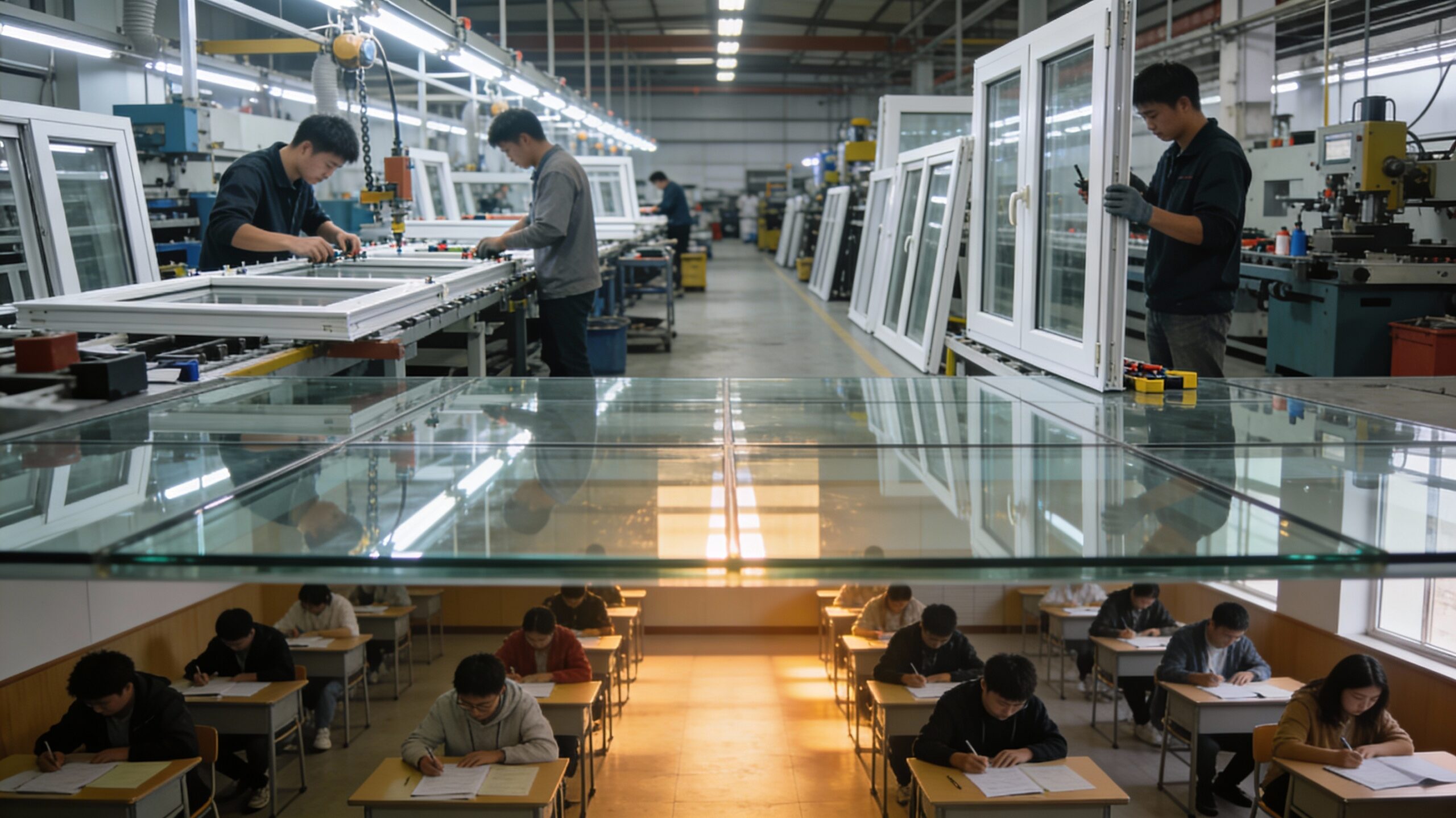

In America’s industrial heartlands, a quiet transformation is under way that could determine whether the nation’s fenestration industry, the craftspeople and engineers who manufacture windows, doors and glass, survives the coming decade.
The sector faces an acute workforce crisis. Some 400,000 manufacturing positions remain unfilled across the United States today. By 2033, projections suggest nearly 4mn roles will exist, with half expected to remain vacant. For the glass and fenestration world, dominated by small-to-mid-sized enterprises, these are not merely statistics but an existential threat.
Tony Davis, National Director of FAME USA at the Manufacturing Institute, believes the answer lies in dismantling what he calls the “college for all” mentality that has shaped cultural expectations for generations. The traditional four-year degree, he argues, is not the only path to a lucrative, high-tech career. “We are seeing a cultural shift,” Davis observes, noting that conventional academia often fails to meet the demands of modern manufacturing. The FAME (Federation for Advanced Manufacturing Education) model offers an alternative: a “degree apprenticeship” delivering an associate degree in two years—a timeline Davis describes as “not less than, just faster than” traditional routes.
The approach is deceptively simple yet rigorous. Students divide their week between three days on the shop floor and two days on campus. This “earn and learn” philosophy provides thousands of hours of practical experience in mechanical and electrical engineering, fluid power and robotics. Crucially, it transcends the “binary decision” of university versus vocational training, validating knowledge through both academic transcripts and regular wages.
For smaller window and door manufacturers, who might require only one or two specialist technicians, FAME’s collaborative chapters provide a crucial lifeline. By pooling their training needs, small employers can aggregate demand and join manufacturing giants in forming unified training cohorts. This collaboration grants even modest glaziers access to high-calibre training otherwise beyond their means—potentially determining whether they “gain a contract or lose a contract”.

Yet the curriculum extends beyond technical proficiency. Davis emphasises a “keyboard and a wrench” skill set. As artificial intelligence, automation and robotics become shop-floor fixtures, tomorrow’s workers must become “lifelong learners”. Training encompasses not just technical mastery but “professional behaviours”—teamwork, communication and lean problem-solving principles.
Despite FAME’s success, Davis cautions that policy makers remain behind the curve. He identifies a “disconnect” whereby officials seek a single “hammer” for every “nail”, rather than supporting diverse, employer-led initiatives. He advocates for funding mechanisms that reward collaboration and support training for “incumbent workers” already employed.
Nevertheless, grounds for optimism exist. The “perception gap” is narrowing. When teenagers witness the sophisticated reality of modern, automated glass facilities, outdated stereotypes of “dark, dirty and dangerous” manufacturing dissolve.
“What we’re doing in manufacturing is forward-facing,” Davis concludes. By embracing technology and collaborative training, the fenestration industry is not merely filling vacancies but cultivating a resilient, adaptable workforce prepared for constant change. For an industry that literally frames our view of the world, the outlook is finally becoming clear.