

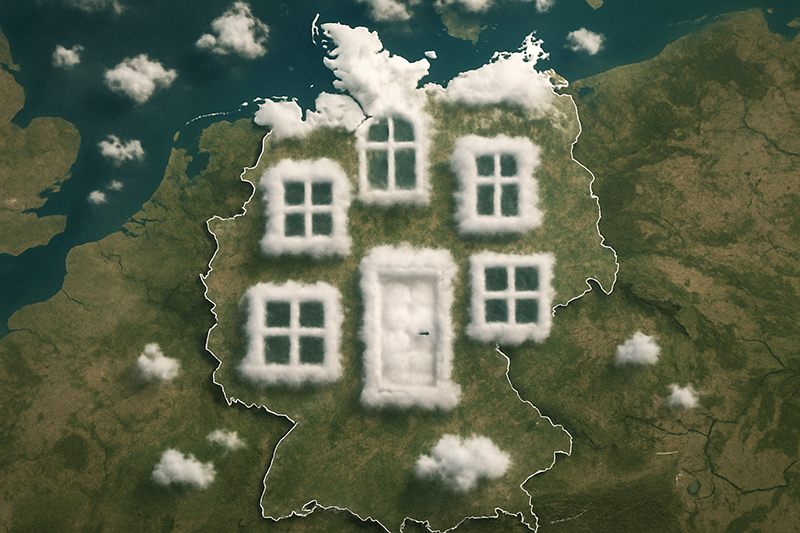

After two years of contraction, Germany’s fenestration sector is showing tentative signs of stabilisation, reports Glazingtoday.com editor Mark Thompson. Industry executives and analysts are increasingly confident that 2025 will mark the beginning of a gradual recovery, led not by new residential construction but by renovation and energy-efficiency upgrades underpinned by government subsidies.
The statistics tell the story of a sector that has endured a bruising cycle. Window sales in Germany fell by around 8.5 per cent in 2024, while external doors dropped by more than 9 per cent, according to data from the industry association VFF. The decline rippled upstream into glass production, with float, coated and insulating glass each registering falls of 6 to 9 per cent as manufacturers idled furnaces to cut capacity.
This sharp contraction reflected a collapse in new housing permits during 2023 and 2024, when rising interest rates, construction inflation and a weakening economy paralysed developers. But the latest indicators suggest that the market is turning a corner, even if the pace of recovery remains muted.
Destatis figures show building permits up year on year in early 2025, with single-family dwellings posting double-digit gains. In June permits rose 7.9 per cent compared with the same month in 2024. The numbers remain historically low, yet the direction of travel offers some encouragement that the trough may have passed.
Business sentiment is also less gloomy. The ifo Institute reported a marked improvement in its residential construction climate index in July, and its August survey of overall business confidence rose slightly, although economists cautioned that the recovery is still weak and uneven.
Most observers agree that renovation, not new build, will provide the main engine of demand over the next 12 months. Germany’s subsidy regime for energy efficiency — particularly the BEG programme administered by KfW — continues to offer grants and low-interest loans for upgrading building envelopes. Windows and doors with superior thermal performance are clear beneficiaries.

“The renovation impulse is stronger than we expected at the start of the year,” the VFF noted in its summer forecast, while adding that new construction remains a “problem child” for the industry. Funding incentives are especially generous for the worst-performing housing stock, with add-ons available for homeowners who commission certified supervision of renovation works.
This policy environment is steering homeowners and installers towards triple-glazed insulating glass units, aluminium-clad frames and other premium specifications that meet subsidy thresholds. Demand is shifting from volume to value, with higher-specification products replacing some of the unit losses caused by weak construction activity.
Upstream, however, concerns are emerging about supply. The Bundesverband Flachglas has warned that curtailed float glass production could create bottlenecks as demand improves. If manufacturers are slow to restart idled lines, insulating and safety glass could face longer lead times in 2025 and 2026, putting upward pressure on prices despite an otherwise subdued cost environment.
Labour availability remains another constraint. While installation capacity was adequate during the downturn, companies now report growing lead times as renovation orders pick up. Bottlenecks in skilled labour could become more pronounced if subsidies stimulate a stronger-than-expected wave of refurbishment projects.
Looking ahead, the consensus forecast is for a flat to slightly positive market in 2025. Windows are expected to record growth of around 0.3 per cent, and doors about 1 per cent, representing stabilisation after steep declines. The real momentum is likely to be in the renovation segment, where mid-single-digit growth is plausible, while new build is forecast to remain subdued, recovering only slowly from its historic lows.
Margins, too, could improve modestly. Energy and input costs have largely stabilised, and selective firmness in glass prices may support manufacturers that have endured two years of falling revenues. For installers, the ability to navigate the subsidy landscape and offer turnkey renovation solutions — including documentation for BEG compliance — will be critical to winning business.
Risks remain. A downturn in the broader German economy, already flirting with stagnation, could derail fragile confidence. Budgetary constraints in Berlin could lead to adjustments in subsidy levels. And uncertainty over the interest-rate path continues to cloud the outlook for housing developers.
Yet the upside potential should not be dismissed. Faster recovery in permits, increased funding for public-sector retrofits, or clear long-term policy signals from government could accelerate the rebound.
For now, Germany’s fenestration industry appears to be stabilising at a low level, with growth prospects shifting from speculative new builds to the tangible business of making old buildings warmer, cheaper to heat and compliant with Europe’s climate ambitions.