

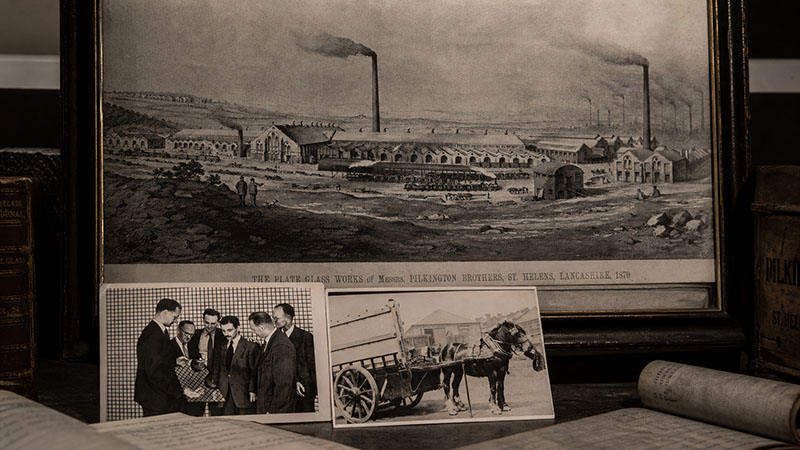


Pilkington UK is marking its 200th anniversary, celebrating two centuries since four local families founded the St Helens Crown Glass Company in Merseyside in 1826.
The business, now part of the NSG Group, began in the same year that the internal combustion engine was patented and the first photograph was taken. It was renamed Pilkington Brothers in 1849 after William and Richard Pilkington acquired the company, before becoming Pilkington Ltd in 1894.
From its base in St Helens, the company grew into one of the best-known names in global glassmaking. It began selling internationally in 1892, opening agencies across Europe, North America, Australia and elsewhere, and later establishing factories in countries including Argentina, Australia, Brazil, Canada, America and South Africa.
A defining moment came in 1959, when Sir Alastair Pilkington invented the float glass process, in which molten glass is floated on a bath of molten tin. The technique made it possible to manufacture large, flat, clear sheets of glass continuously and to a uniform thickness.
The company says the process helped transform modern architecture and remains the most widely produced form of glass in the world.

Pilkington glass has also been used in cars including the Model T Ford, Land Rover, Rolls-Royce and Aston Martin, as well as buildings such as the Empire State Building in New York, the Pyramide du Louvre in Paris and The Shard in London.
Despite its international growth, the company has retained strong links with St Helens. At its peak, it employed more than 11,500 people in the town. Today, Pilkington UK employs about 3,000 people across sites in the UK, having become a wholly owned subsidiary of NSG Group in 2006.
Its modern product range includes Pilkington Activ, described by the company as the world’s first self-cleaning glass; Pilkington Suncool, which reflects solar radiation to help keep buildings cool; and Pilkington K Glass, which acts as insulation to help retain heat.
The company also plans further investment at its St Helens base this year, including new coating technologies intended to support the next generation of architectural glass products.
Neil Syder, managing director of Pilkington UK, said it was “truly a privilege” to play a part in the company’s 200-year story.
He added that Pilkington had “made an impact around the world” from its home in St Helens, and praised past and present colleagues who had contributed to its history.
Mr Syder said the company completed a multi-million-pound investment in a new sustainable production line at Greengate Works in 2025, as part of efforts to cut greenhouse gas emissions by 30 per cent by 2030 and reach net zero by 2050.
Why This Matters: Pilkington’s bicentenary underlines rare continuity in UK glassmaking, but the sharper message for fabricators, installers and specifiers is confidence: a domestic supplier still investing in coatings, sustainability and product innovation. For customers, that means proven heritage backed by practical performance gains in energy efficiency, solar control and self-cleaning glass today.