

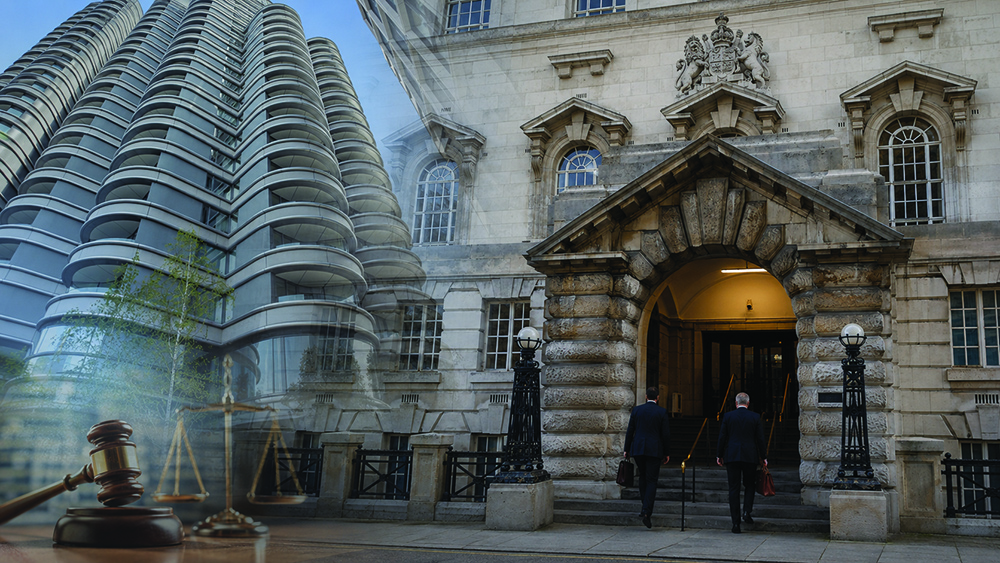


Four companies, including the internationally renowned architecture practice Foster + Partners, are due to stand trial this summer over the death of a coach driver killed by a pane of glass that fell from a luxury London riverside development.
The case is scheduled to begin at Inner London Crown Court on 6 July, nearly eight years after Mick Ferris, 53, was crushed outside The Corniche on the Albert Embankment.
Mr Ferris, a driver for Clarkes of London and a devoted West Ham United supporter, died at about 10.40am on 2 October 2018 after a window pane fell around 250ft from a penthouse apartment on the 25th floor. He had been returning to his vehicle, which was parked opposite Tate Britain.
Foster + Partners is accused alongside Lindner Prater Ltd, Wintech Ltd and St James Group Ltd, part of the Berkeley Group. Each company faces a charge of failing to discharge a duty under section one of the Health and Safety at Work Act 1974.
Prosecutors allege the firms exposed members of the public, including Mr Ferris, to risks linked to the “outward opening penthouse window vents” at the development.

The case is expected to draw close attention from the construction and glazing sectors, raising questions about design responsibility and safety oversight in high-rise residential schemes.
The Corniche was marketed as an “exclusive riverside address” and contains 252 apartments, with homes advertised at prices of up to £6.25m. But the building’s glazing had been the subject of concern before the fatal incident.
In August 2017, while the scheme was still under construction, a window fell from the same top-floor apartment involved in the later tragedy. Two workers narrowly avoided injury.
After that earlier failure, St James Group said a full investigation had been carried out and that the window design was “amended in accordance with expert advice”. The subsequent death of Mr Ferris, however, prompted a fresh investigation by the Health and Safety Executive and police.
In the immediate aftermath of the 2018 incident, residents at The Corniche were told to keep windows and balcony doors closed as a precaution while inquiries continued. Developers said at the time that windows on lower floors did not pose a risk.
The forthcoming trial is expected to examine how the penthouse window system was designed, assessed and managed, and why prosecutors say it continued to present a danger after the earlier incident.
The four companies are due to face proceedings at Inner London Crown Court from 6 July.
Why This Matters: The Corniche prosecution recalls the death of lawyer Amanda Telfer, 43, who was killed in Hanover Square in August 2012 when three large, unglazed window frames, weighing more than half a tonne in total, toppled onto her as she walked past a Mayfair construction site. The frames had been left unsecured near a public pavement, and the case later led to criminal convictions, including gross negligence manslaughter for a site supervisor.
For the fenestration sector, both cases underline that duty of care does not stop at the building envelope or site boundary. Contractors, installers and project managers must identify risks to workers and the public, secure heavy or elevated components, and act decisively after prior warning signs. Failures in design, storage, installation or temporary protection can become fatal public-safety breaches, with serious legal consequences.