
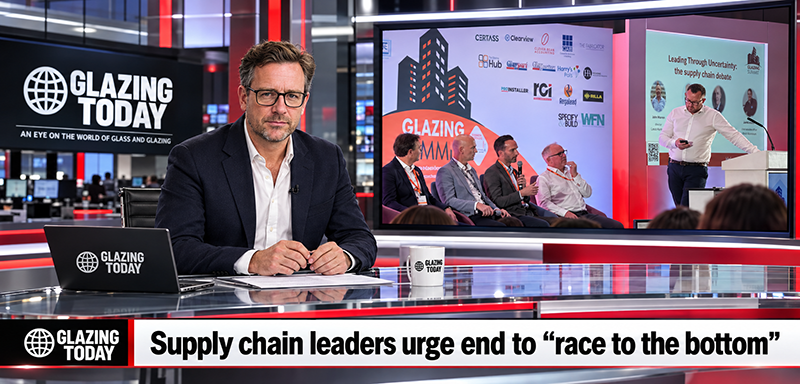

A panel of window and glass sector leaders at the recent Glazing Summit have called time on the industry’s “race to the bottom” on price, urging a reset towards values-based procurement, compliance and long-term margins, as trading conditions tighten and regulation sharpens.
Chaired by John Warren, director at Lasco Marketing, the session brought together manufacturers, systems houses and machinery suppliers to examine how the supply chain can steady the sector through tougher macro headwinds flagged by the Bank of England earlier in the day. The message from the floor was strikingly consistent: competing on headline price alone is eroding balance sheets, undermining quality, and rewarding the worst behaviours in the market.
“The problem we’ve got is a race to the bottom,” said Shaun Mackey from Jade Engineering. “If all we talk about is price, all we’ll ever do is focus on price, and not on the positive things suppliers bring: compliance, training, sustainability.” Peter Dyer, head of commercial at Deceuninck, argued the lens needs to shift from price to demand creation. Citing research that only 14% of retail consumers are satisfied with the sales process, he said the sector is leaving growth on the table by failing to educate decision-makers across fragmented procurement chains. “We’ve got to think strategically about the next five years, broaden our markets and challenge our own perceptions,” he added.
Atlas Aluminium’s CEO, Jamie Newall, who took charge after investors acquired an aluminium business out of administration in December 2024, pressed for discipline around cost and margin. “Your margins should drive prices,” he said, attacking “per leaf” pricing for bifold doors as economically incoherent given the underlying variance in size, configuration and inputs. “We know our bills of material, time-and-motion, overheads. If competitors undermine the basics of running a business properly, you can’t compete with that.”
The panel confronted head-on the sector’s uneasy tolerance of pre-packs and phoenix companies. Newall noted HMRC is “always the biggest creditor” when firms collapse. “If we accept that HMRC loses tens of thousands, hundreds, millions in tax, we all pay more,” he said, arguing repeated phoenixing damages the industry’s reputation for responsibility and reliability. Shaun framed the answer as collective ethics: “We can deal with it. You just don’t buy from them.” He urged buyers to align procurement with the values they sell — quality, sustainability, apprenticeships, safety — and to stop rewarding bad actors.
Machinery suppliers highlighted secondary fallout from failures: waves of used equipment hitting the market depress sales of new, more efficient kit and slow innovation. “It doesn’t allow new technology to come through,” said Flat Glass Solutions’ managing director, Dave Cahill, warning that cash-strapped buyers default to older, second-hand machines.

On regulation, the panel’s consensus was pragmatic: policing matters because it creates commercial value for compliant firms. Newall recounted buying a rival’s “1.2 U-value” bifold only to find the foam missing. “If no one’s policing that, who will drive the push to quality?” Mackey countered that policing shouldn’t be just top-down: procurement teams must demand and verify compliance at the point of purchase with certifications and documentation. Dyer said confusion persists among specifiers and builders navigating standards from the Building Safety Regulator to NHBC, and called for a sustained education drive — particularly as energy efficiency intersects with comfort in a warming climate and with rising energy price caps.
Looking ahead, supply risks drew a wary but measured response. Newell pointed to aluminium supply vulnerabilities if Middle East tensions escalate. Dyer referenced tanker insurance and refinery bottlenecks feeding inflationary pressure, particularly on diesel logistics, while Cahill flagged Pilkington’s planned float line cold repair over Christmas as a near-term glass constraint and stressed the sector’s exposure to power prices as a high-energy industry.
Operational resilience advice was practical: service contracts, preventative maintenance and in-house training to curb downtime when critical parts are delayed. Relationships also matter: trusted machinery partners “bend over backwards” in a crisis.
Could automation by larger fabricators squeeze out smaller players? The panel thought not. Smaller firms retain advantages in responsiveness and the personal touch, while “interrupted, integrated” automation, targeted fixes like loaders or bottleneck solutions, can pay off without a full smart factory, Cahill said.
A recurring blind spot is the missing installer voice. Warren counted only a handful of installers in the room, despite their pivotal role in translating quality and compliance to homeowners and commercial clients. Newall said the channel has shifted: showroom installers have fallen from 60% to 24% of Atlas’s customer base over eight years, with online now the second-largest group. That distance raises the bar on reliability, first-time-right quality and warranty support, the true cost of a cheap frame is the return visit, he warned.
When asked how to balance values-based decisions with shareholder returns, Newell said leadership example-setting and choosing the right investors is critical. Atlas retained 92% of legacy customers post-deal, he said, after a countrywide effort to explain new ownership and approach, and by voluntarily paying almost all creditors of the old company.
The remedy, ultimately, is collective and systematic: systems houses to offer real-time stock visibility and complete component coverage; buyers to enforce compliance at source; sector bodies to align messages; and the industry to pivot its story from price to margin, performance and lifetime value. As Dyer put it: stop treating products as commodities, join up the chain, and educate the customer. Do that, and conversion improves without chasing ever-more leads, and without racing to the bottom.