

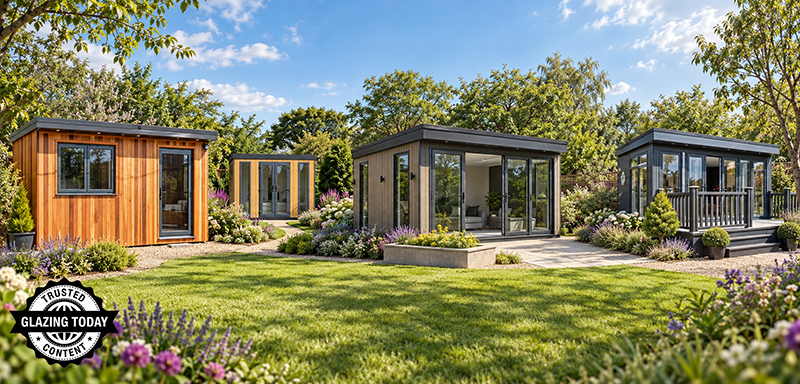

Garden rooms give UK window and door installers a fresh route to higher average order values. This exclusive white paper investigates the market and offers useful insight.
Executive summary
British homeowners are increasingly choosing to upgrade rather than uproot, and the garden room is becoming the default way to buy space without moving. For window and door installers, it is a glazing-rich product that sells to customers they already have.
- Demand: 61 per cent of homeowners would consider a garden room rather than moving, and 21 per cent of Britons say their home is too small, according to Electric Radiators Direct research.
- Economics: in a Leeds case study, a £13,500 garden room avoided about £20,000 in moving costs and a £500-a-month mortgage increase.
- Value: agents put the uplift from a well-built, insulated garden room at 5 to 15 per cent of property value.
- Product shift: rooms are getting larger and more glazed, with demand moving to fewer, bigger openings and sliding doors.
- Supply: Eurocell now sells installed rooms from £8,499 and a trade-friendly Studio Build kit from £6,999.60; Express Bi-Folds supplies trade-ready garden room doors and windows within five working days.
- Risk: planning limits, Building Regulations thresholds at 15m² and 30m², electrics and use creep demand new survey and contract disciplines.
The conclusion: installers who add garden rooms — led by the glazing and bundled with base, electrics and heating — can lift order values, smooth seasonal workloads and defend glazing share against specialist garden room brands.
1. The renovate-or-relocate calculus has tilted towards staying put
For a growing share of UK households, the cheapest square metre is now at the bottom of the garden. New consumer research from heating specialist Electric Radiators Direct finds that 21 per cent of Britons feel their home is too small, and that 61 per cent of homeowners would consider a garden room rather than moving to gain space (Brit Brief, 5 August 2026).
The arithmetic behind that sentiment is stark. The research is anchored by a Leeds case study: a couple with a home valued at about £335,000 faced roughly £20,000 in moving costs and a target property nearer £450,000. Their monthly mortgage would have risen from £800 to £1,300.
Instead they spent about £13,500 on a garden room. It freed a bedroom for a nursery and created a separate home office. Even the most expensive quote they received, at about £25,000, still beat moving on cost.

Estate agents told the couple the building could add up to 15 per cent, or about £50,000, to the property’s value. Robin Edwards of buying agent Curetons puts the typical uplift for a well-built, insulated garden room at 5 to 15 per cent, with buyers increasingly treating such rooms as part of the house.
For installers, the significance lies less in any single anecdote than in the decision it represents. A household that chooses to stay is a household that spends on its home — and a garden room is, in large part, a glazing project with a roof on it.
2. A market growing up — bigger, warmer and more glazed
The garden room has graduated from lockdown novelty to a mainstream home-improvement category. Industry estimates widely cited in the trade value the UK garden rooms market at about £226m in 2024 (Primethorpe Paving, citing industry data) — small beside replacement windows, but concentrated in the owner-occupier households installers already serve.
The product itself is changing in ways that favour the glazing trade. Data from builder Cabin Master, reported by Shedworking, shows:
- Average floor area rose from 16.3m² to 17.5m² in a year — edging towards the 15–30m² band where Building Regulations tests begin to bite.
- Installations of its largest door size grew 30 per cent in 2025, and builds using its largest windows rose 18 per cent, even as the number of window units per build fell.
- Sliding doors featured in 64 per cent of builds in 2025, up from 58 per cent in 2023, with bi-folds declining slightly.
- Fully timber buildings fell from 7.7 per cent of builds in 2023 to 3.1 per cent in 2025, displaced by hybrid and composite-clad designs.
In plain terms, buyers want fewer, larger, higher-specification glazed openings. That is precisely the product mix — aluminium sliders, wide-span bi-folds, fixed full-height lights — on which fenestration installers earn their best margins.
Use is no longer confined to the home office. Eurocell markets its rooms as gyms, studios, bars, games rooms and home salons, and its case studies show rooms repurposed as household needs change (Eurocell). That flexibility underpins the resale-value argument, and with it the homeowner’s willingness to spend.
Planning remains a central selling point. In England most garden rooms fall under permitted development, subject to limits including a single storey, a 2.5m maximum eaves height, and a 2.5m overall height within 2m of a boundary (Planning Portal). Listed buildings, flats and designated land carry tighter rules.
3. Why the window installer is the natural seller
The installer’s advantage is not a new skill but an existing relationship. The household weighing a garden room is usually the same household that has bought windows, a composite door or a conservatory in the past decade. It already trusts a local firm to work on its property, survey accurately and finish cleanly.
Four overlaps make the product a logical extension of a window and door business:
- Glazing content. Doors and windows are the most visible — and often the most valuable — components of a modern garden room. Cabin Master’s data shows that content growing in size and specification.
- Survey and site skills. Measuring openings, assessing access, levelling and squaring are daily work for fitting teams. Eurocell’s own Studio Build guidance stresses that door operation depends on a square, level structure — a familiar discipline.
- Thermal literacy. Installers already sell on U-values, warm-edge spacers and draught-proofing. A garden room used year-round is a thermal-envelope sale, and the conversation about insulated walls, roof and floor is one installers can lead.
- Finance and aftercare. Many firms already offer consumer finance, guarantees and FENSA or CERTASS paperwork. Garden rooms slot into the same sales, finance and warranty infrastructure.
The commercial logic is basket-building. A homeowner buying a set of replacement windows can, with the same salesperson and survey, be offered a room that starts at £8,499 fully installed through Eurocell’s entry range (Eurocell). For a firm whose order book has been squeezed by soft RMI demand, that can comfortably double the potential value of an appointment.
There is also a defensive case. Specialist garden room brands increasingly specify premium aluminium glazing in-house. An installer who does not offer the room risks watching the glazing on it go to someone else.
4. The supply side: window manufacturers move into the garden
The clearest signal that garden rooms are becoming a fenestration category is that the industry’s own suppliers are building ranges for them. Two approaches have emerged: complete room systems, and glazing packages engineered for other people’s rooms.
Eurocell: a full room system with a trade route
Eurocell, the PVC-U systems house and distributor, now runs garden rooms as a distinct business. It says it has sold more than 20,000, backed by a 10-year guarantee on professionally installed ranges and its network of 200-plus branches (Eurocell).
The line-up has been reorganised into three installed tiers — Studio Fusion, Studio Select and Studio Signature — differentiated by size, colour and layout choice. Earlier launches added the Studio View, Studio Frame and Studio Canopy styles, each with an electric pack, panel heater and double-glazed doors and windows as standard, alongside FSC-certified timber and recyclable cladding (Professional Builder). Eurocell has also invited firms to become Select Installers of its garden rooms.
For installers who want to own the whole job, the Studio Build kit is the more interesting product. Eurocell pitches it explicitly at trade installers as well as confident DIY buyers. It uses insulated SIP wall panels, PU-insulated roof panels and a 75mm PU-insulated floor, with Anthracite Grey woodgrain French doors and two full-height fixed lights (Eurocell Studio Build).
| Eurocell range | Route to market | Entry price (inc VAT) | Notes |
|---|---|---|---|
| Studio Build 2.4m x 2.4m | Kit, trade or DIY install | £6,999.60 | SIP walls, French doors |
| Studio Build 3.6m x 2.4m | Kit, trade or DIY install | £8,499.60 | As above, larger footprint |
| Studio Fusion | Fully installed | £8,499 | Focused specification |
| Studio Select | Fully installed | £9,999 | More sizes and colours |
| Studio Signature | Fully installed | £12,199 | Electrics included; most personalisation |
The spread matters for installers. A kit retailing at about £7,000 against an installed room from £8,499 leaves a visible margin for a firm that can supply the base, labour, electrics and finishing itself.
Express Bi-Folds: the glazing package for the garden room
Leeds-based Express Bi-Folding Doors approaches the market from the opening outwards. It says it supplies glazing, roofing and door systems for garden rooms across the UK and Ireland, with bi-folds from two to seven panels and a full sliding-door range (Express Bi-Folds).
Its trade arm offers a pre-made Express Selection, delivered within five working days, including door and window products specifically sized for garden room installations (Express for Trade). It also stocks Anthracite 7016 garden room doors at 1,950mm high — a height chosen to sit comfortably within permitted development limits (Express Bi-Folds).
Express offers trade installation training and a trade-and-install service, and works with several prefabricated and bespoke garden room manufacturers (Express case study). Its Leeds showroom now features an Exterior Spaces range of bioclimatic pergolas and shading, widening the outdoor-living basket further (HBD).
The two models suit different installers. Eurocell offers a turnkey building and branch-backed supply; Express offers fast-turnaround, premium aluminium openings that can lift the specification of almost any room.
5. The commercial model: from add-on to average order value
The garden room’s value to an installer lies less in the structure than in everything sold around it. A kit room is a platform; the margin sits in the base, the services and the upgrades.
| Revenue line | Who typically delivers it | Commercial note |
|---|---|---|
| Room structure (kit or system) | Manufacturer supply, installer fit | Price-transparent online; thin margin if sold bare |
| Glazing upgrades (wider sliders, bi-folds, extra fixed lights) | Installer | Core competence; strongest margin lever |
| Base and groundworks | Installer or subcontractor | Site-specific; priced after survey |
| Electrical supply and connection | Qualified electrician | Part P notifiable work; a safety-critical line |
| Heating (electric radiators, panel heaters) | Installer or electrician | Low-cost, high-perceived-value add-on |
| Decking, canopy, blinds, flooring | Installer or partners | Lifts ticket and finish quality |
The Electric Radiators Direct research points to heating as one such line. The Leeds couple heat their room with an electric radiator, independently of the house, and report it stayed warm and usable through winter (Brit Brief). The company argues that zoned electric heating makes year-round use affordable without loading the main system.
The conservatory comparison is instructive. Garden rooms compete for the same “extra space” budget as conservatories and orangeries, but carry less of the conservatory’s reputation for being too hot in summer and too cold in winter. For installers whose conservatory volumes have faded, the garden room offers a way to re-enter that budget with a more insulated, more flexible product.
Finance broadens the addressable market. Eurocell already offers payment options on its installed rooms. A room priced at £8,000–£15,000 becomes a monthly figure that sits beside — not instead of — a window or door order.
Seasonality is a further attraction. Window replacement tends to be weighted towards autumn, when homeowners notice draughts and heating bills. Garden rooms are typically bought for spring and summer use, offering a counter-cyclical stream that can smooth fitting-team utilisation.
6. Risks: where the garden room can go wrong for an installer
The opportunity is real, but the garden room is a building, not a window. Firms that treat it as a bolt-on product without new controls risk reputational damage that spills into their core business.
Planning and permitted development. “No planning needed” is a sales line, not a guarantee. Permitted development excludes listed buildings, flats and maisonettes, and sites with Article 4 directions. On designated land, side-of-house outbuildings need consent, and in National Parks and AONBs buildings more than 20m from the house are capped at 10m² (Planning Portal). Verandas and platforms above 0.3m are not permitted development — relevant to canopy-style designs.
Building Regulations. Rooms under 15m² with no sleeping accommodation are normally exempt. Between 15m² and 30m², exemption depends on the room being at least 1m from a boundary or built substantially of non-combustible materials (Planning Portal). With average sizes now near 17.5m², installers need a boundary-distance check in every survey.
Use creep. A room sold as an office that becomes a bedroom or annexe falls outside both outbuilding planning rules and the Building Regulations exemption. Contracts and handover documents should state the intended use.
Electrics. Consumer complaints about third-party garden room installs frequently centre on mains connection and isolation. Electrical work must be carried out and certified by a competent, registered electrician. Installers subcontracting it remain answerable to the customer.
Subcontracted delivery. Where manufacturers use regional fitting partners, the brand on the product and the firm on site may differ. Installers acting as Select or approved partners should agree clear standards on site cleanliness, programme and snagging.
Price transparency and competition. Kit prices are published online, so bare-structure margins are exposed. The defence is specification and service: survey, base, electrics, heating and glazing upgrades bundled into one accountable contract.
7. Recommendations and outlook
Installers that move now can claim the garden room as a fenestration product before specialist brands lock up the glazing on it. Seven practical steps:
- Pick a supply model. A turnkey system such as Eurocell’s suits firms wanting a branded, guaranteed building with minimal design risk. A glazing-led model with suppliers such as Express suits firms that want to differentiate on premium aluminium openings.
- Start with a kit project. A Studio Build-type kit lets fitting teams learn base, panel and roof sequencing on a contained job before taking on bespoke rooms.
- Lead with the glazing. Sell the opening first — wide sliders, bi-folds, full-height lights — in line with the shift towards fewer, larger units.
- Build the services bench. Secure a registered electrician and a groundworks partner before marketing the product.
- Add a compliance step to every survey. Check permitted development status, boundary distances, room size against the 15m² and 30m² thresholds, and intended use.
- Mine the existing customer base. Past window, door and conservatory customers are the warmest leads; the renovate-not-relocate message fits naturally into follow-up marketing.
- Bundle heating and finance. Offer electric heating and monthly payment options as standard to support year-round use and widen affordability.
The outlook is supportive. The Electric Radiators Direct research suggests six in ten homeowners would consider a garden room over moving. Agents point to value uplifts of 5 to 15 per cent. Manufacturers from PVC-U systems houses to aluminium specialists are building ranges and trade routes around the category.
The risk for installers is not that the garden room fails to grow, but that it grows without them. For a sector built on adding light, space and value to the British home, the bottom of the garden is the obvious next frontier.
Sources
- Electric Radiators Direct — Renovate or relocate: why garden rooms mean more homeowners are choosing to upgrade than uproot
- Brit Brief — Mum saves £500 on mortgage with £13.5k garden room, 5 August 2026
- Eurocell — Garden Rooms
- Eurocell — Studio Build self-build garden rooms
- Professional Builder — Elevating outdoor spaces with Eurocell Garden Rooms
- Express Bi-Folding Doors — Garden room ideas
- Express Bi-Folding Doors — Express for Trade and the Express Selection
- Express Bi-Folding Doors — Increased product offering through Express Bi-Folds Direct
- Express Bi-Folding Doors — A Grand Garden House case study
- HBD — Discover what’s new at Express for 2026
- Shedworking — Garden room trends for 2026 (Cabin Master data)
- Primethorpe Paving — Landscaping statistics UK 2026
- Planning Portal — Outbuildings: planning permission
- Planning Portal — Outbuildings: Building Regulations