
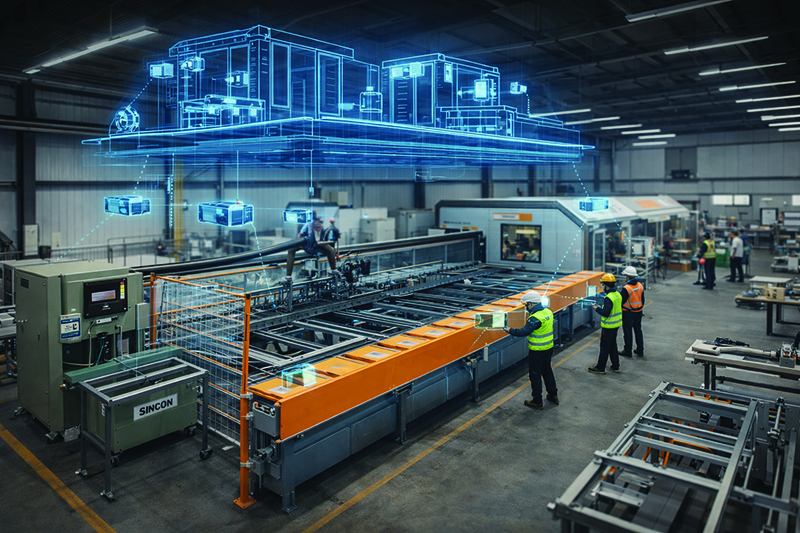


Digital twins are beginning to give window and door fabricators a new way to test production decisions before they affect the factory floor. By creating a live digital replica of a production line, manufacturers can simulate machine behaviour, product flow and workforce conditions, allowing engineers to anticipate problems and optimise performance before they occur.
For a sector where margins are tight and product variation is high, the approach is emerging as a practical application of Industry 4.0 technologies in day-to-day manufacturing operations.
A virtual replica of the production line
In a fabricator’s factory, a digital twin functions as a continuously updated virtual model of the production line. Sensor data from CNC machining centres, corner cleaners, saws and handling systems feeds into the model, creating a real-time picture of how machines and processes behave.
For factories heavily reliant on CNC machining, the twin can collect information such as spindle load, vibration, temperature, axis position and tool life. When combined with order data from ERP or production planning systems, the model gradually builds a “fingerprint” of normal operation across different profile systems and tooling sets.
This baseline allows engineers to test production schedules, profile changes or shift patterns digitally before implementing them on the shop floor.

Moving maintenance from calendar to condition
One of the most immediate applications lies in predictive maintenance. Instead of relying on fixed maintenance intervals, digital-twin systems can analyse sensor patterns and estimate the remaining useful life of components such as cutting tools, spindles and drive systems.
If the model detects abnormal behaviour, for example a gradual rise in vibration on a CNC axis during specific machining operations, it can predict when a component is likely to fail. Maintenance can then be scheduled during planned production gaps, reducing unplanned downtime and preventing disruptions that cascade through cutting, welding and glazing operations.
The same approach can be extended to ancillary equipment such as corner cleaners. Monitoring cycle times, electrical current and positional accuracy allows the twin to identify subtle performance changes that may lead to quality issues or rework if left unchecked.
Because the system also has access to production orders, it can simulate the effect of temporarily removing a machine from the line and rerouting work across other equipment or shifts while maintaining delivery commitments.
Testing changes before metal is cut
Digital twins also enable manufacturers to simulate process changes in advance. An engineer introducing a new tooling package for an aluminium CNC, for example, can load expected cutting forces and feed rates into the digital model. The twin then runs a simulated production shift using historical order data to predict spindle loads, tool wear and cycle times for different product types. If the simulation suggests higher failure risk or excessive tool wear, parameters can be adjusted digitally before the change reaches the physical machine.
Linking process data to product quality
Another emerging development is the integration of AI-based machine vision with digital twins. Autonomous visual inspection systems can learn what a “good” product looks like from a small sample of reference parts and then inspect frames in real time for defects.
For window manufacturing, this includes checking welded frames, corner cleaning, hardware placement and gasket fit while detecting issues such as scratches, incomplete machining or mis-cut drainage slots.
When inspection data feeds back into the digital twin, it creates a closed loop between machine performance and product quality. Each defect can be linked to its originating machine, operator or batch of material, allowing the model to identify patterns – such as welding faults linked to equipment misalignment or temperature drift.
Over time, predictive models can incorporate these quality signals alongside sensor data, allowing systems to flag “quality degradation risk” before visible failures occur.
Inspection systems designed for production flow
Autonomous inspection platforms are designed to minimise integration overhead, allowing manufacturers to deploy vision systems quickly and scale them across multiple stations.
For a fenestration plant, this means inspection points can be positioned at key stages – after welding and corner cleaning, before glazing, and during final assembly – without extensive custom engineering.
Because the AI learns acceptable product characteristics from reference samples rather than detailed programming, new profile systems or product variants can be introduced with minimal setup time.
Monitoring the human element
The data-driven approach is also beginning to extend beyond machines to the workforce. Research into fatigue monitoring suggests AI systems can estimate operator fatigue levels using biometric signals such as heart rate variability and behavioural cues including blink rate, posture and gaze direction.
Trials in safety-critical environments have shown high accuracy in identifying reduced alertness and early signs of fatigue, with some systems exceeding 96% accuracy when combining wearable sensors and video inputs.
In a production environment, these fatigue scores could be fed into the digital twin alongside machine and process data. When thresholds are exceeded, the system could recommend task rotation, micro-breaks or assistance from collaborative robots to maintain productivity while reducing the risk of human error.
Implications for UK manufacturers
Together, digital twins, AI-driven inspection and workforce monitoring are forming a more comprehensive view of the modern factory. For window and door manufacturers, the combined approach offers several potential benefits: improved uptime for capital-intensive machinery, reduced scrap and rework through earlier detection of process drift, and better management of operator fatigue.
In a sector characterised by complex product mixes and increasing customisation, the ability to test production changes digitally – while linking machine health, product quality and workforce performance – could become a significant competitive advantage.
The result is a manufacturing model where problems are anticipated rather than reacted to, and where production decisions can be rehearsed in the digital world before they affect the physical factory floor.