

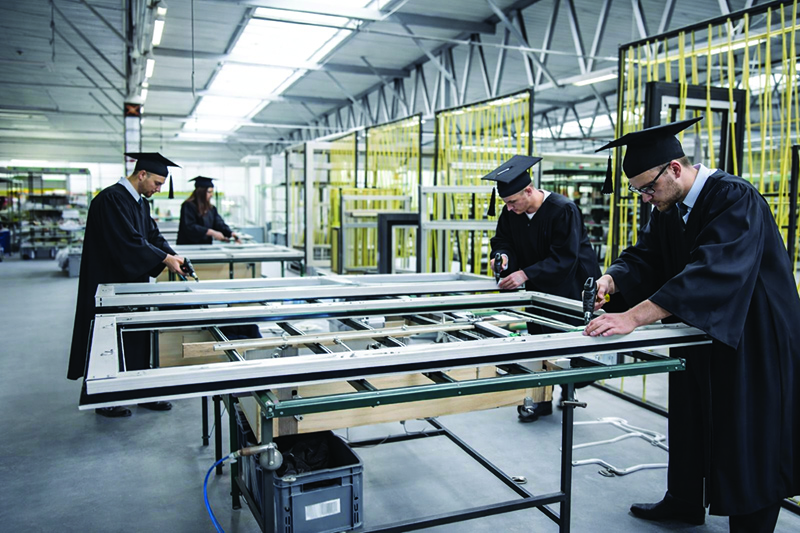


For decades, the script for British teenagers has been written in the hallowed halls of academia. UCAS applications, carefully curated personal statements, and the inevitable weight of student loans have become the standard rites of passage. Yet, as the average debt for English graduates climbs to a staggering £53,000, a quieter revolution is taking place on factory floors and in design studios across the country. The traditional university route, once the undisputed golden ticket to the middle class, is facing an identity crisis.
Roger Hartshorn, the Chairman at Garner Holdings and Garnalex Aluminium Extrusion, represents a generation that remembers a different landscape. In the mid-1980s, only about 15 percent of young people followed the academic route to university. It was an elite system designed for those pursuing specific paths in law, medicine, or finance. Today, that figure has nearly tripled, reaching approximately 50 percent of school leavers. Hartshorn, who began his own career as an apprentice toolmaker at sixteen, argues that we have allowed university to become a default setting that frequently overlooks the inherent value of practical mastery.
The financial contrast between these two paths has never been more visible. While graduates enter a competitive workforce under a cloud of interest-bearing debt, apprentices are building equity in their own skills from day one. Analysis from the Centre for Social Justice reveals a sobering reality: over 700,000 degree-educated individuals in the UK are currently out of work and claiming benefits. Conversely, Level Four apprentices are found to earn an average of £5,000 more than their graduate peers after five years in the workforce.
Darren Waters, a Non-Executive Director at Michelmersh Brick Holdings, notes that while university changed his life during the 1980s, the environment has shifted. He observes that there are now too many graduates chasing fewer jobs, and many are saddled with loans they will never realistically repay. For Waters, the tide is turning in favour of apprenticeships as businesses look to fill critical gaps in key trades.
However, the cultural bias remains a formidable barrier within the education system. Bizzy Saunders, a Head of Data Governance at Shawbrook Bank, points out that even prestigious grammar schools often provide zero support for vocational pathways, focusing entirely on the university track. This sentiment is echoed by Sarah Hitchings, a Sales and Marketing Director who left sixth form after just one week because it felt wrong. She eventually found her footing through a commercial traineeship, but she recalls with disappointment that she was never made aware of apprenticeships as a viable option during her school years.
The rise of artificial intelligence adds a new layer of urgency to this debate. Joseph French suggests that as AI begins to automate research and data-heavy roles, the unique physical effort required by joiners, bricklayers, or electricians will remain indispensable. He believes that while AI can harvest information from the web in milliseconds, it cannot replace the years of hands-on experience required to master a physical craft. Saunders adds that traditional university courses may struggle to keep pace with a world where the careers of the next decade do not even exist yet.

For Hartshorn, the proof of the apprenticeship model is found in his own family. All of his children chose the vocational route, with his sons now holding senior leadership positions within his companies. He views the “earn while you learn” philosophy as a deliberate strategy to combat the skills shortage currently plaguing the manufacturing and construction sectors. The economic argument for the taxpayer is equally compelling: research suggests that for every £1 invested in apprenticeships, the UK economy gains approximately £21 in return.
The challenge ahead is as much cultural as it is economic. Success, as Hartshorn suggests, should be defined by what an individual achieves and the value they bring to the world of work, not simply by whether they attended a lecture theatre or a workshop. For many young people, the most effective classroom is the workplace itself. It is time to provide the vocational route with the same respect we afford the degree, ensuring that the next generation can build a future based on experience and confidence rather than just theory and debt.