

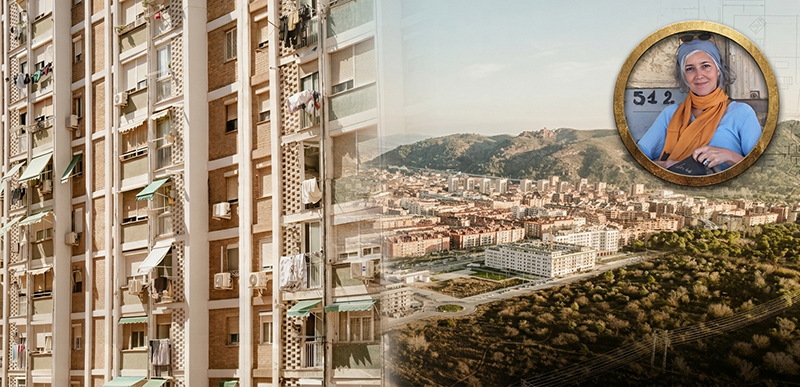

Across Europe, housing is in crisis. Limited social housing and a 93% rise in short-term rentals are driving prices up while wages stagnate, leaving millions unable to afford secure homes. Beyond the current geopolitical crisis, extreme temperatures continue to account for rising energy bills. As buildings account for 36% of EU CO₂ emissions, Europe needs to deliver more energy-efficient homes without deepening this social and environmental crisis.
In Spain, where social and affordable housing remains below 3%, the challenge is particularly acute. But across Catalonia in north-eastern Spain, an alternative housing system is emerging: one that recognises housing as a human right, a pillar of the welfare state and a path to addressing inequality and climate change.
Spain’s housing system has long relied heavily on home ownership. Its low stock of social housing leaves public authorities with limited power to intervene on price rises. When Spain’s property bubble burst in 2008, it exposed a housing system built on speculation rather than stability. More than 3.4 million homes were left empty and hundreds of thousands of families were evicted.
The echoes of the financial crash still reverberate today: declining access to homeownership has pushed more households into the rental market, increasing pressure on rents. The same forces have seen speculative investors and lucrative tourist rentals displacing long-term residents. By the 2010s, housing costs rose nearly 70%. In 2024, more than 27,564 households were evicted across Spain, with an estimated 700,000 people across Europe forced from their homes involuntary each year.
Meanwhile, 80% of tenants in Madrid and Barcelona report serious issues with the condition of their housing. This leaves a greater number more exposed to hotter summers, colder winters and rising energy bills, with the poorest most exposed to inadequate building conditions and rising energy costs. If the low-carbon transition does not address these social issues or exacerbates socio-economic inequalities, it will fail.
In part, a just transition involves decarbonising buildings and the urban environment while enhancing existing homes and infrastructure to strengthen communities rather than displacing them. Affordable energy retrofitting programmes can reduce CO₂ emissions, tackle energy poverty and address health inequalities.

Catalonia’s “just” response to its housing crisis involves collaboration. Public authorities, non-profit providers, businesses and cooperatives share responsibility for building and retrofitting homes that are affordable, low-carbon and socially impactful.
In Barcelona, Casa Bloc is an early 20th-century complex restored by the non-profit housing association Hàbitat3. The 17 flats combine sustainability features, like triple-glazed windows and a communal heat pump, with social support for vulnerable families.
In Sitges, a coastal town south-west of Barcelona, average rents are around €18 (£15) per square metre. One affordable eco-housing scheme has buildings with an AA energy rating with rentals of just €6 per square metre.
Adela Barquín, a rental building for over-65s, promotes physical and social wellbeing by incorporating active‑ageing principles. This includes low-maintenance, well-planned layouts that foster movement and social activity. The building also uses ultra-low-energy passive heating and cooling systems that keep indoor temperatures comfortable. This costs residents just €500 per month, less than half the going rate of Barcelona’s average rents of €1,193.
Over the past decade, partnerships have been formalised through networks like Cohabitac, a Catalan coalition of non-profit housing organisations managing around 5,000 affordable homes. Cohabitac is now a trusted partner to public authorities.
The success of initiatives like these relies on public policy that reduces risk, protects the social function of housing and encourages collaboration between public authorities, civil society, businesses and investors.
Municipal governments have played a central role. Barcelona City Council’s public-social partnership mobilises non-profit providers to develop and manage affordable housing on public land under long-term arrangements. Similar approaches operate in cities such as Vienna or Lyon.
Meanwhile, investment from public, cooperative and mission-driven investors supports housing models that focus on long-term affordability and sustainability. Collective efforts that bring together residents, policymakers and non-profit organisations could be replicated in other housing systems too.
The Catalan model does face hurdles. Land values are high. Construction costs are rising. Many projects still depend on time-limited EU COVID recovery funds. Balancing ecological performance with affordability continues to be a delicate task.
But the direction of travel is clear. Catalonia’s housing system is being reimagined as social infrastructure for a low-carbon age. This is backed by public policy and long-term investment, including a €31 million Council of Europe Development Bank loan.
Energy retrofits completed since 2020 are saving 18,000 tonnes of CO₂. One Barcelona study found that every euro spent on retrofits saved €2.30 in health and energy subsidies. These initiatives are making housing a right for everyone, challenging the commodification of housing while contributing to decarbonisation, people’s wellbeing and social cohesion. More than 1.6 billion people worldwide lack access to adequate housing. That figure is expected to rise to 3 billion by 2030.
Catalonia’s ten-year shift from housing “market” to housing “system” demonstrates how embedding human rights in decarbonisation unlocks social-economic change. Improving housing equality is linked to building climate resilience. Emission-cutting insulation prevents weather-related illness. Retrofitting by socially inclusive coalitions reduces energy bills and creates jobs.
The Catalan model is small-scale yet distinctive. It cultivates public-private-social collaborations to reduce CO₂ emissions and challenges the view of homes as financial assets over places to live.
Adriana Allen is Professor of Development Planning and Urban Sustainability, UCL
Why This Matters: The model illustrated here to create a social infrastructure for a low-carbon age is a great example of how the problem of lack of affordable and low-carbon homes can be tackled. The funding element of this example is key to its success. The mix of key stakeholders working together is the crucial as investment from public, cooperative and mission-driven investors facilitates the creation of homes under a workable system. The UK has the most energy inefficient housing stock in Europe and its is hope policy makers and developers will take a close look at the example shown in Spain.