

An audit of two construction manufacturers found total AI visibility for branded queries – and as little as 3% for the questions specifiers actually ask
A specifier needs a low-carbon flooring product, or a window system that clears Part L with headroom. Once she would have scrolled a page of blue links. Today she is as likely to ask ChatGPT, which returns a synthesised answer, a recommendation and a handful of sources. If a manufacturer isn’t in that answer, it was never really in the running.
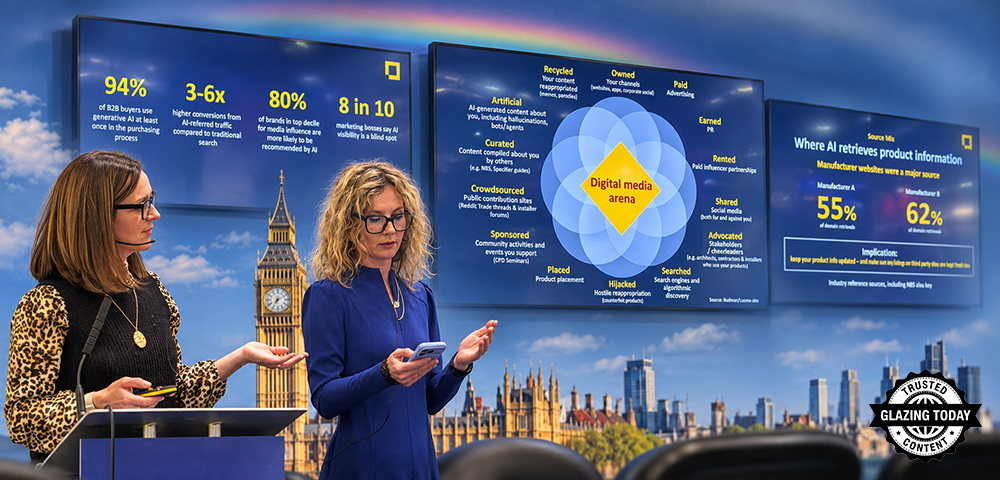
That was the warning at the heart of a session at London Build, where Ros Rowlatt, digital media director, and Joanna Wilmot, PR director, both of The Think Tank, set out how construction manufacturers are – and aren’t – being found by large language models. Its most uncomfortable evidence came from a mini audit of two anonymous manufacturers, tested with 25 prompts each across ChatGPT, Google’s AI Overviews and Microsoft Copilot over a week.
When prompts named the brands, both scored 100% visibility. Strip the names out – the way a specifier asks which products suit an application – and visibility fell to 35% for one and 3% for the other.
It varied sharply by topic, too. One manufacturer appeared in 84% of answers about its core material, 34% for a specific application and none at all for sustainability questions, despite what Wilmot suspected was a hefty sustainability marketing budget.
The pair were careful to call it an illustrative snapshot, not a benchmark. But the pattern will be familiar to any fenestration brand that owns searches for its own name and disappears when the query becomes “triple-glazed window, Uw 0.8, Passivhaus retrofit”.

The wider figures cited point the same way. Almost all B2B buyers now use an LLM at some stage of purchasing, and AI-referred traffic reportedly converts at three to six times the rate of conventional search, because the machine has already pre-qualified the shortlist. Yet eight in 10 marketing leaders describe AI visibility as a blind spot, and roughly half of B2B marketers who have checked say what the models report about them is wrong.
Inaccuracy is the quieter danger. Models stitch answers together from manufacturer websites, NBS records, certification bodies, trade press, LinkedIn, Reddit and Glassdoor, and they make no distinction between what a company says about itself and what others say. Where information is fragmented or contradictory, they infer – often wrongly. A thermal figure in a brochure that differs from the one on a third-party database is exactly the inconsistency that gets misreported.
In the audit, manufacturer websites made up just over half of the sources retrieved, with NBS-related pages featuring heavily. The website is the foundation, but only part of the record.
Rowlatt’s prescription is less exotic than the problem. Keep sites crawlable, fast and error-free; use schema markup; put key technical data on web pages rather than locking it in PDFs. Write journalistically – “65% market share”, not “leading company” – with summaries and FAQ sections that mirror how buyers phrase questions. Build test prompts from real language: Search Console data, sales teams and CPD presenters who hear what specifiers actually ask.
Earned media matters more, not less, Wilmot argued. Models favour credible titles and trade press, and breadth and repetition of coverage beat a single high-authority hit. Original data – performance results, survey findings – makes a manufacturer the citable source. Freshness counts as well: 65% of AI-cited pages are said to be less than a year old.
None of this, the pair concluded, is a separate discipline. It is consistency, credibility and relationships – old principles applied to a reader that never sleeps and always checks whether a company’s story holds together.
For an industry that sells on certified performance, that should be an advantage. The question is whether the data is where the machines are looking.