

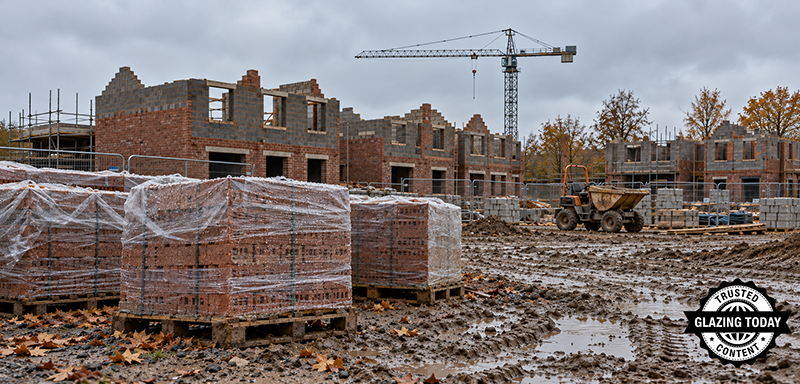

CPA’s Noble Francis warns that rising mortgage rates, a weaker Bellway outlook and mounting regulatory costs point to a bleak winter for housebuilding. Fewer bricks left UK yards in the first eight months of 2026 than in 2020, the year construction stopped for three months during the first pandemic lockdown. Brick deliveries are the industry’s best monthly proxy for new housing starts, so this is a stark reading. According to Noble Francis, Economics Director at the Construction Products Association, the worst may not yet be over.
Deliveries in August fell 8.7% on July and were 10.1% lower than a year earlier, according to government figures. They were 36.4% below the 2018–19 average, before the run of shocks that began in 2020, and 43.9% below the spring 2022 peak. Year-to-date deliveries are down 10.4% on 2025 and 32.3% below the 2022 high.
For fabricators and installers supplying new build, the figures are an early warning, because frames follow walls.
“This is concerning,” says Francis. The industry is only beginning to feel what the initial Middle East conflict has done to housing demand and costs since July. The rises in oil, energy and mortgage rates since September are still to come through, and he expects them to weigh on demand in the fourth quarter and especially in the first half of 2027.
The mortgage market supports that view. The Bank of England recorded 54,918 approvals in August. That was 1.8% fewer than in July, 16.0% fewer than a year earlier and 21.0% below January 2020. The average two-year fixed rate at 75% LTV rose to 4.77% from 4.68%, against a February low of 3.93% before the conflict. By September it had reached 4.93%. With bond yields climbing sharply, Francis expects approvals to fall in Q4, though where rates and lending will settle is unclear.
He is sceptical about the government’s ‘Your First Home’ scheme. It may help some first-time buyers in expensive regions, he says, but analysts’ forecasts of a 10% rise in completions next year “appear to be guesses at best”. The price caps and income thresholds have not been set yet, and with rates rising, monthly repayments rather than deposits may become the main barrier for buyers.

Affordability is not the only problem. In London, developers also face leasehold and service charge concerns, late-stage viability assessments, financing costs, stamp duty, the second staircase requirement and weak foreign investment. Taylor Wimpey recently said it would exit new-build residential once its current developments are complete. In cheaper regions, Francis argues, the binding constraint is site viability, made worse by government-imposed costs. The Building Safety Levy took effect this month, and the Future Homes and Building Standards follow in March 2027, although there is a one-year grace period.
Bellway’s full-year results show how this plays out for a housebuilder. Completions rose 10.8% to 9,695. But in the nine weeks from 1 August, private reservations per outlet per week fell to 0.50 from 0.51, and to 0.45 from 0.48 excluding bulk sales. Because its order book is thinner, the housebuilder is targeting 9,000–9,400 completions in FY27. That would be a fall of 3.0–7.2%, leaving output 16–20% below FY22. It also expects to rely more on bulk sales and warns that its underlying operating margin “will reduce further”, as build cost inflation and elevated sales incentives outweigh efficiency gains.
Francis expects at best a seasonal uptick in September, and says Q4 2026 and Q1 2027 “are still likely to remain very difficult.” He hopes for a better second quarter and second half of 2027, helped partly by weak comparisons with the year before.