

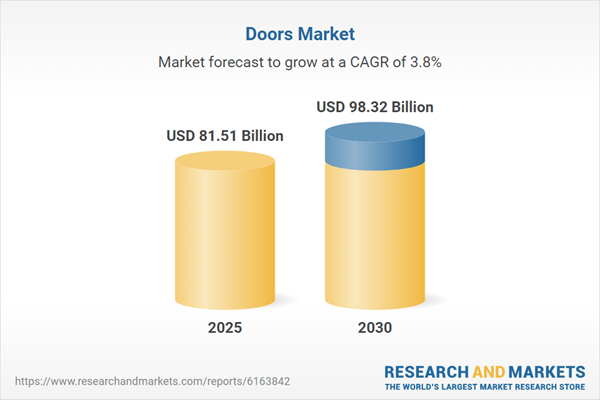

The global doors market is projected to grow from $81.51bn in 2025 to $98.32bn by 2030, according to new industry data, representing a compound annual growth rate of 3.8 per cent.
Growth is being driven by rising demand across residential, commercial, and industrial sectors for doors that offer enhanced security, energy efficiency, and performance. Manufacturers are responding with products engineered for durability, insulation, soundproofing, and weather resistance, making them suitable for both interior and exterior use.
Modern doors increasingly incorporate fire-resistant materials, automated locking mechanisms, and sustainable or recyclable components. As buildings are designed to meet higher standards in safety and sustainability, doors have become central to both performance compliance and aesthetic appeal.
“Demand for high-quality, adaptive designs has been supported by precision manufacturing and bespoke production methods,” the report notes. “Doors are now as much about comfort and design as they are about safety and structure.”
In 2024, new construction accounted for the largest share of the global doors market, fuelled by increased development across housing, commercial, and infrastructure projects. Urbanisation, strong housing demand, and public incentives for affordable homes were cited as key contributors.
The report highlights that this growth has coincided with a shift towards energy-efficient, fire-safe, and accessible building designs. Government-backed initiatives, such as housing schemes and smart city projects, are encouraging the uptake of advanced door technologies and materials.

Interior doors made up the largest segment of the market in 2024, underpinned by strong construction and renovation activity. Widely used for privacy, noise reduction, and spatial division, interior doors have benefited from changing lifestyle preferences and increased disposable incomes. A broad selection of materials and finishes, as well as innovations in smart-home integration and sustainable production, have reinforced their popularity.
Asia Pacific led all regions in market share in 2024, bolstered by rapid urban growth, infrastructure investment, and government-backed housing initiatives in countries including China and India. The region’s dominance has been further supported by low production costs and rising foreign investment in construction and real estate.
Large-scale developments such as India’s Pradhan Mantri Awas Yojana and China’s urban renewal programmes have accelerated demand for modern door systems. Smart city initiatives and industrial corridors are also contributing to a rise in advanced, automated, and energy-efficient door installations.
Leading companies profiled in the report include ASSA ABLOY (Sweden), LIXIL Corporation (Japan), Cornerstone Building Brands and JELD-WEN (US), Allegion (Ireland), dormakaba Group (Switzerland), YKK AP (Japan), Owens Corning, Andersen Corporation, and Miter Brands (all US-based).
Why This Matters: Looking at the reasons for this growth is very interesting. It comes from all the sectors, from residential to industry, and the drivers are universal. Security, energy efficiency and performance are the top three areas that drive this growth. Nothing is really different in these from the last ten years. These are the areas customers focus on when they are installing new doors. What has changed is the quality of the products available. This makes the purchasing decision all the easier – and this explains the growth. Innovation is at the heart of this and here lies the key to continued success.