
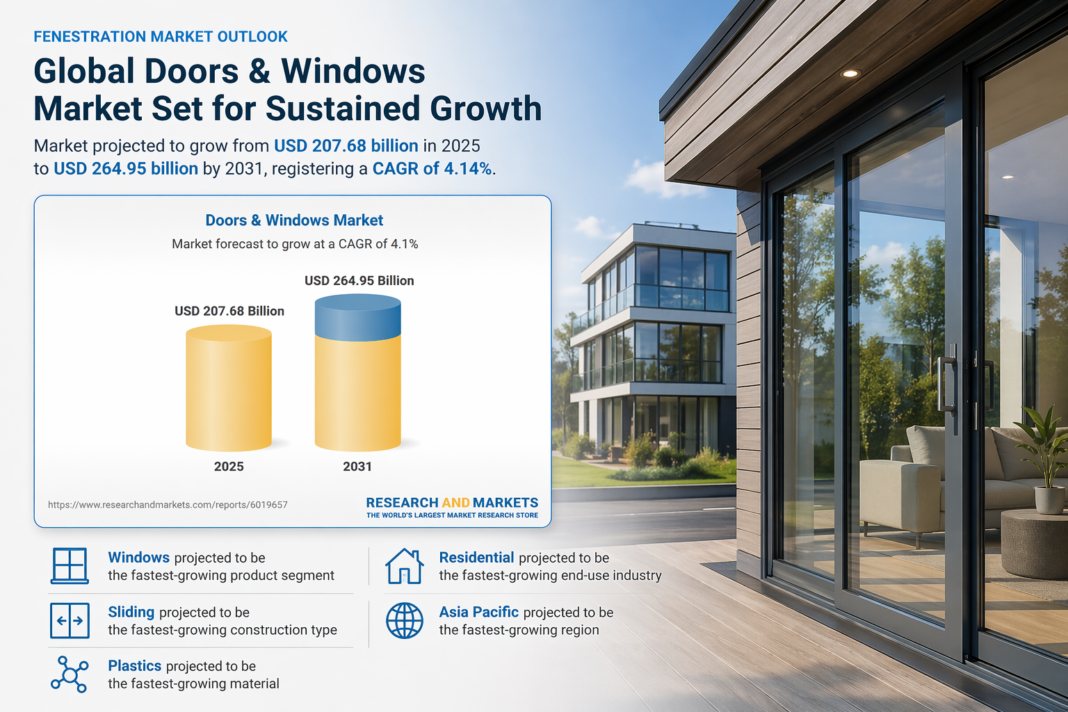

The global doors and windows market is on a clear upward path, with the latest Research and Markets outlook projecting it will rise from USD 207.68 billion in 2025 to USD 264.95 billion by 2031. That represents an increase of more than USD 57 billion over the forecast period, with the market advancing at a CAGR of 4.14%.
For the fenestration sector, the message is straightforward. Demand is being underpinned by a combination of new-build activity, rising renovation expenditure, urban expansion and a stronger focus on energy efficiency. Doors and windows remain fundamental parts of any building envelope, but the report makes clear that their role is now far broader than basic access and daylighting. They are increasingly tied to a building’s performance, appearance, insulation and long-term value.
This changing role is helping to support steady global demand. As developers and homeowners place more emphasis on airflow, energy savings and design, doors and windows are becoming more central to decisions on both new construction and refurbishment. The report highlights that building rehabilitation, remodeling and replacement are now major contributors to market momentum, alongside fresh housing and commercial development.
The importance of the renovation market is particularly notable. According to the report, in the US the National Association of Home Builders expects single-family housing starts to increase by around 1% in 2026 to approximately 940,000 units, followed by a further rise of about 5% in 2027 to nearly 984,000 units. At the same time, the share of home improvement expenditure has climbed from more than 33% in 2007 to about 45% by the third quarter of 2025. This is a significant indicator for the wider market because it reflects the growing weight of upgrade and replacement activity, a trend that directly benefits suppliers of more advanced, energy-efficient and resilient door and window systems.
One of the most important findings in the report is that windows are expected to be the fastest-growing product segment during the forecast period. That growth is being driven by the increasing demand for energy-efficient buildings, greater emphasis on ventilation and the continued appeal of natural light. Modern window systems are being positioned not simply as glazing products, but as tools for improving thermal insulation, reducing energy consumption and enhancing overall building performance.
This is particularly relevant as sustainability becomes more deeply embedded in construction thinking. The report points to improved glazing performance and smart window technologies as additional growth factors. At the same time, the use of vinyl, aluminum, fiberglass and composite materials in window frames is helping the segment evolve, offering broader design options and better performance characteristics. In practical terms, that places windows at the heart of both premium specification and volume housing demand.

Construction type is another area where the report identifies a strong trend. Sliding products are projected to be the fastest-growing construction type in the doors and windows market. Their growth is tied closely to modern architectural preferences and the realities of compact urban living. Because sliding doors and windows operate on horizontal rails and do not require swing clearance, they are especially suited to smaller spaces, balconies, patios, apartments and high-rise residential developments.
The report also notes the visual and lifestyle appeal of sliding systems. Their ability to accommodate large glazed areas supports demand for more daylight and uninterrupted views, both of which are increasingly sought after in residential and commercial buildings. This has made sliding formats attractive not only in compact homes, but also in luxury housing, hotels and office environments where the emphasis is on creating a seamless connection between indoor and outdoor space. Material change is supporting this shift as well, with movement away from wood and towards aluminum and uPVC, often combined with double- or triple-glazed panels.
Material trends are another defining feature of the forecast period. Plastics are expected to be the fastest-growing material segment, largely because of the expanding use of uPVC and other polymer-based frame systems in both residential and commercial construction. The report attributes this momentum to a combination of durability, corrosion resistance, low maintenance requirements and strong thermal insulation performance.
These advantages are particularly important in markets where cost, energy efficiency and product longevity all matter. Plastic-based systems also offer resistance to moisture, chemicals and environmental degradation, which broadens their appeal across varied climatic conditions. In addition, the material supports flexible design and cost-effective manufacturing, making it suitable for both mass-market new build and renovation programmes. As demand grows for sustainable and energy-saving products, plastic frames appear well placed to strengthen their position further.
From an end-use perspective, residential is projected to be the fastest-growing sector. This reflects the strength of several connected drivers: housing construction, rapid urbanisation and the worldwide surge in home improvement activity. Demand for single-family homes, apartments and multi-family developments is increasing the need for doors and windows in new projects, while existing homeowners are investing more heavily in replacements and upgrades to improve security, efficiency and appearance.
The report suggests that the residential sector is also shaping the type of products being specified. Larger windows, sliding doors and energy-efficient glazing are all benefiting from changing consumer preferences. Alongside this, there is growing interest in products that can offer better thermal insulation, sound attenuation and weather resistance. For the market, this means residential demand is not only expanding in volume terms, but also encouraging a shift towards more sophisticated and higher-performing systems.
Geographically, Asia Pacific stands out as the fastest-growing region in the global doors and windows market. The drivers are large-scale and long term: rapid urbanisation, population growth and major development programmes. The report cites the United Nations Development Programme in stating that Asia Pacific’s population is likely to reach 4.84 billion by 2050, with 64% expected to live in urban areas. That level of urban concentration points to substantial housing demand and, by extension, significant growth potential for the doors and windows sector.
India and China are central to this regional story. In India, the urban population is projected to reach 600 million by 2036, a trend that is expected to increase demand for doors and windows considerably. Government-backed programmes such as the Smart Cities Mission and the Atal Mission for Rejuvenation and Urban Transformation are identified as important contributors to development activity and therefore to market growth.
The report’s regional composition further underlines Asia Pacific’s weight in the market outlook, with the breakdown given as Asia Pacific 40%, North America 20%, Middle East and Africa 20%, Europe 10% and South America 10%. While the report excerpt does not expand on the meaning of these percentages beyond regional information coverage, it reinforces the importance of Asia Pacific within the overall global picture.
Overall, the outlook for the global doors and windows market is one of resilient, broad-based growth. New construction remains important, but the market is increasingly being shaped by renovation, energy efficiency, material innovation and the demand for better-performing building products. Windows, sliding systems, plastic frame materials and residential applications are all expected to outperform the wider market, while Asia Pacific is set to lead regional expansion.
For companies across the fenestration supply chain, that creates a clear commercial direction. Growth is likely to come not just from volume, but from alignment with the main forces now shaping demand: urban living, thermal performance, modern design and replacement-led upgrading. Businesses able to match those requirements with efficient, durable and design-led solutions will be best placed to benefit from the market’s next phase.
The full 390-page report is available from Research and Markets. For more details CLICK HERE