

There is a palpable buzz around Jensen Huang. The leather-jacketed chief executive of NVIDIA, the chipmaker currently at the epicentre of the artificial intelligence earthquake, exudes a confidence that is both infectious and slightly unnerving. When asked when we might see robots with human-level capabilities, his answer is immediate and startlingly precise.
“Next year,” he states, with no hint of hyperbole. When pressed, he simply smiles. “Because I know how fast the technology is moving. You’re going to see some pretty amazing things.”
Is this the swagger of a CEO whose company has become one of the world’s most valuable, or a genuine glimpse into a future that is arriving faster than almost anyone imagines? The evidence suggests it might be the latter. Huang’s confidence is not built on fanciful dreams, but on silicon. NVIDIA’s latest chips are said to be ten times more powerful than their predecessors. When bundled together by the thousand in vast data centres, they create the computational firepower required to teach an AI about the complexities of the physical world.
The real breakthrough, however, is what comes next. Once this vast, world-aware AI model is created, a compressed version of it can be placed onto a much smaller, more efficient chip. This chip can then be embedded directly into a robot, giving it the ability to process information and make decisions locally, on the device itself.
This is the critical step, the one that untethers robotics from the cloud. A robot cannot afford the latency of consulting a remote server when it’s about to collide with a person or drop a valuable object. “What you’ve really done,” explains one technologist on the ground, “is you’ve given the robot a brain. Once they’ve got brains, well, the sky’s the limit.”
This sentiment is echoed across the industry’s frontiers. “Everybody who is in this industry, who’s on the frontier of this research, believes we now have the basic ingredients to build everything we need for the kinds of robots we’ve been imagining,” says an expert from the sector.

From Dance Floor to Factory Floor
What exactly are they imagining? For many, the image that springs to mind is one of Boston Dynamics’ creations. The company’s agile, dog-like Spot robots and the bipedal Atlas humanoid are arguably the most advanced machines of their kind. At demonstrations, they perform feats of incredible technical sophistication – choreographed dances that are both impressive and slightly surreal.
Yet, a moment during one such showcase revealed the profound challenge that remains. After the intricate dance routine, one of the robots attempted to open a door. The process was painfully, excruciatingly slow. This is the paradox of modern robotics: machines can master tasks humans find incredibly difficult, like complex acrobatics, while struggling with actions we find trivially easy, like navigating a doorway. A pre-programmed dance is one thing; dynamically understanding and interacting with an unpredictable world is quite another.
This is why your robot butler is not coming next year, despite Mr Huang’s bullish timeline. Robert Playter, the founder of Boston Dynamics, is quick to manage expectations. “We think that’s the wrong strategy,” he says of the push for a consumer-ready home robot.
He cites three major hurdles: cost, safety, and complexity. Early-stage robots are prohibitively expensive for a mass market. More importantly, the home is a chaotic, unpredictable environment. “Safety is paramount,” Playter notes. “I can’t wait to have a robot that’s helping lift me out of bed when I’m 20 years from now, right? But that’s a really critical safety issue.”
The solution, according to the industry’s leaders, is to start with industry. The first widespread applications for these new, brain-powered robots will be inside factories and warehouses. These are controlled environments, akin to roads with clear rules and objectives, where the goals are well-defined and the tasks are often repetitive, dirty, or dangerous.
The AI Immigrants
This shift towards industrial application inevitably raises the spectre of mass unemployment. If robots can perform manufacturing jobs, what becomes of the human workers?
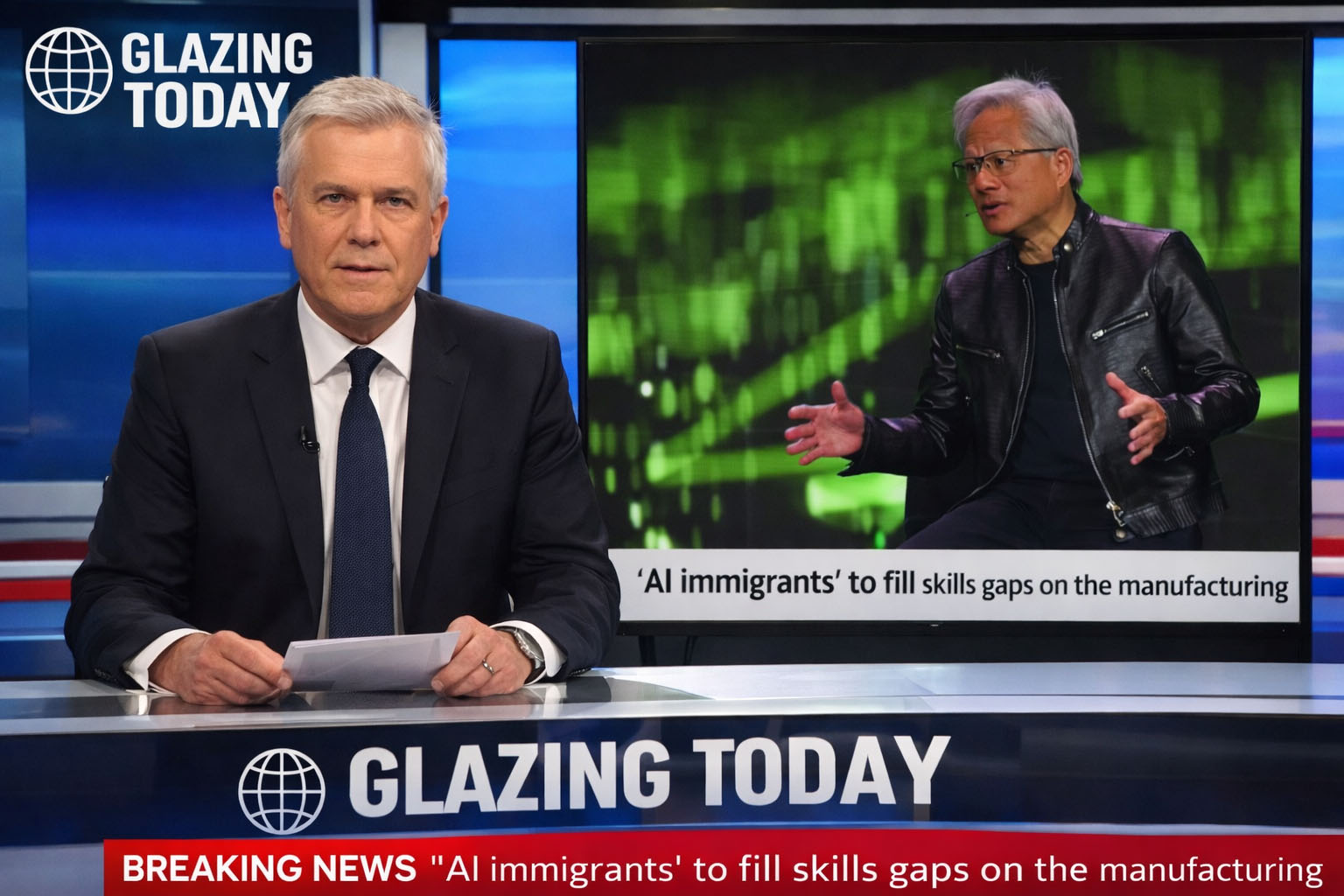
Mr Huang is resolute that the outcome will be the opposite of what many fear. “Having robots will create jobs,” he insists. “We have a labour shortage in the world. Not by one or two thousand people, but by tens of millions of people. And it’s going to get worse.” In his view, we need “AI immigrants” to fill these gaps on the manufacturing floor, performing work that humans are increasingly unwilling to do.
It’s a vision of human-robot collaboration, not replacement. Mr Playter concurs, arguing that this technological wave will create an entirely new industry that didn’t exist a few years ago. “Let the robots do the truly dull, dirty, and dangerous stuff,” he urges. “Let people manage robots, build robots, service robots… I actually think there’s a huge opportunity.”
The immediate future of robotics, then, may look less like a sci-fi blockbuster and more like a highly optimised logistics centre. It might not be as cool or futuristic as a humanoid companion, but its economic impact could be far more profound. As we stand on the precipice of this new era, walking into uncharted territory with our new mechanical co-workers, the only certainty is that the world of work is about to be fundamentally, and irrevocably, re-engineered.
John Cowie – AI and Manufacturing Correspondent