

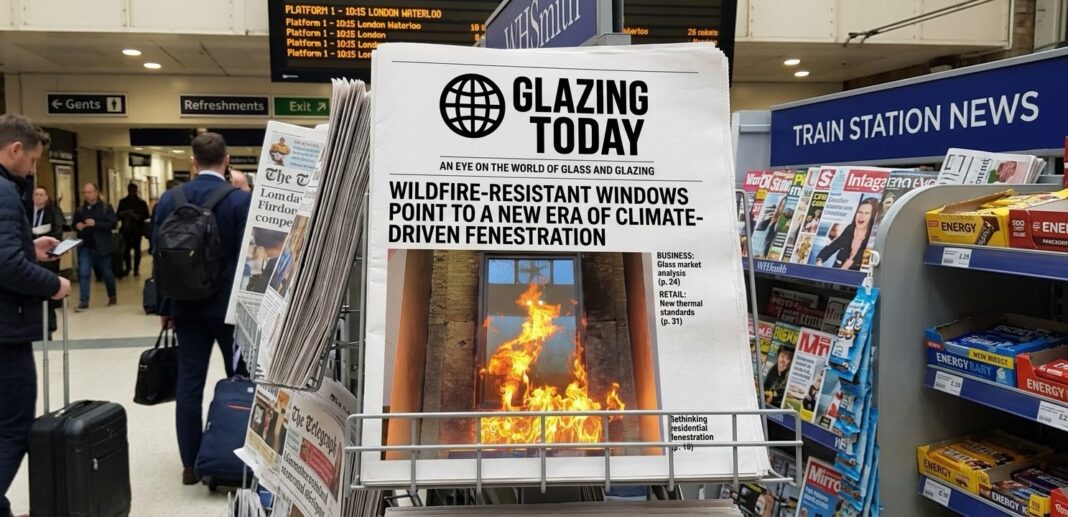


The window industry has spent much of the past three decades improving products to keep buildings warmer and reduce energy consumption. A new generation of fenestration products suggests manufacturers may increasingly have to design for a rather different challenge: surviving the consequences of a changing climate.
Canadian manufacturer Cascadia Windows & Doors has won a 2026 Window + Door Award for its Universal Series Wildfire Resistant windows, developed for buildings in areas exposed to wildfire risk.
The significance lies less in the award than in the performance requirement behind it.
Cascadia says the products are Canada’s first windows to pass California’s SFM Standard 12-7A-2 wildfire testing. The test examines how exterior windows respond to some of the conditions experienced during wildfires, including ember exposure, radiant heat, direct flame and the potential for glass breakage.
The windows use Cascadia’s thermally efficient fibreglass framing system, with two wildfire-resistant specifications available. Its enhanced WFR Plus option incorporates a fire-retardant additive into the fibreglass frame resin to slow ignition and reduce flame spread.
This is an interesting development because it illustrates how the definition of a high-performance window is beginning to broaden.

Traditionally, fenestration manufacturers have competed around thermal efficiency, weather resistance, security, acoustics and aesthetics. Climate change introduces another consideration: resilience.
Canada provides an obvious example. The country’s government warned ahead of the 2026 wildfire season that persistent drought conditions combined with above-normal temperatures were creating conditions favourable to wildfires, particularly across western regions.
Windows can represent a vulnerable point in the building envelope during such events. Once glazing fails or flames and embers penetrate an opening, the ability of the wider structure to resist fire can be compromised.
This helps explain why California’s testing methodology is influencing thinking beyond the US. Canadian wildfire guidance referenced by Cascadia recommends testing window glazing using the SFM 12-7A-2 standard.
For the international fenestration industry, however, the wider lesson is not simply about wildfire.
Different markets are confronting different manifestations of a changing climate.
In Britain, overheating and solar gain are moving higher up the building-performance agenda. Elsewhere manufacturers may increasingly need to design around wildfire, extreme rainfall, hurricanes, stronger winds or severe temperature fluctuations.
That could gradually alter product development.
The industry’s historic pursuit of a universally “better” window may give way to products optimised for the particular environmental risks associated with their location.
For manufacturers, that presents both complexity and opportunity. Climate resilience could create new performance categories, testing requirements and premium products, while giving architects another consideration when specifying the building envelope.
Cascadia’s wildfire-resistant window is consequently interesting not simply because of what it protects against.
It offers an early indication of where fenestration may be heading.
The window of the future may not merely have to conserve energy and provide daylight.
Increasingly, it may have to help a building survive the climate outside.
Why This Matters: The summer of 2026 has provided further evidence of the growing threat posed by extreme weather. Floods and wildfires are placing communities under increasing pressure, while other natural hazards, including earthquakes, continue to expose weaknesses in the built environment.
Buildings represent the first line of defence, yet their failure can have deadly consequences for those inside. Designing components capable of improving resilience is therefore becoming increasingly important, particularly as recognised danger zones expand into areas previously considered relatively safe. The recent wildfire near Stourbridge illustrates how such risks can reach suburban communities in the UK.
Cascadia’s development of a wildfire-resistant window is a pioneering response. It demonstrates that innovation in fenestration can extend beyond energy efficiency and aesthetics to play an important role in protecting buildings, supporting resilience and ultimately safeguarding lives.