


The escalating conflict in the Middle East is already sending tremors through the UK construction sector, with rising oil, energy and borrowing costs threatening to squeeze margins, delay projects and further weaken confidence across the industry.
It remains early in the crisis and the full economic impact is still unclear. Much will depend on how high oil and energy prices rise and, crucially, how long the disruption lasts. But even within the first month, the warning signs for construction have become hard to ignore.
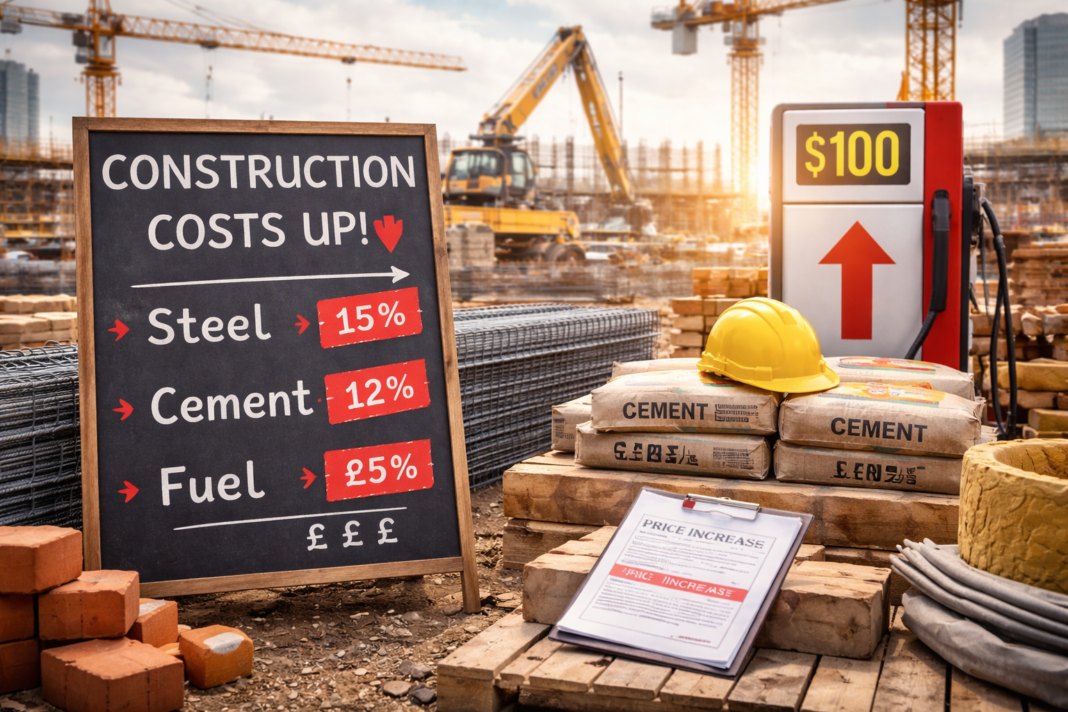
The earliest effects have come through in double-digit percentage price increases for products linked to oil, alongside rising fuel costs. While motorists have seen the change at petrol stations, the effect on construction is broader. Haulage and shipping firms have begun applying additional fuel surcharges, with rates liable to change weekly in line with volatile oil prices. For a sector already operating on tight margins, that creates immediate pressure on procurement, logistics and contract pricing.
Energy is another major concern. UK manufacturers already face energy costs around 60 per cent higher than those in other advanced economies, and for some heavy-side construction products energy can account for as much as a third of total costs. Those higher costs are now rising again. The impact may not be immediate in every case, as some manufacturers buy energy in advance or hedge exposure, but the pressure is building. It will not be confined to bricks, cement, steel and other heavy materials. Rising industrial energy costs are also likely to filter through to light-side products, components and input materials.
The international dimension could intensify the inflationary hit. China remains the UK’s largest source of imported construction products, particularly in lighting and electrical goods. As China depends heavily on Iranian energy, disruption in that market could push up factory and export costs, feeding through to UK import prices. Higher shipping charges will add to that burden.
Steel will be a further headache. Imported steel prices were already set to rise after 1 July because of the government’s new 50 per cent tariffs under its Steel Strategy, irrespective of events in the Middle East. The conflict risks adding another layer of cost pressure to an already sensitive market.

The financial spillover may prove just as damaging. Concerns that the conflict will push up CPI inflation have already lifted swap rates, feeding through rapidly into mortgage pricing. The average two-year fixed residential mortgage rate, which stood at 4.8 per cent before the conflict intensified, had already climbed to 5.6 per cent by Tuesday. Markets are no longer expecting the two interest rate cuts that had previously been pencilled in for this year. Instead, they are pricing in two rate rises, implying mortgage rates of 5.75 to 6 per cent and higher borrowing costs for businesses.
That matters deeply for construction. Higher mortgage rates hit housing demand directly, while more expensive finance makes developers, contractors and investors more cautious. At the start of the year, there had been hopes that confidence would improve modestly once the uncertainty surrounding the government’s Autumn Budget began to fade. Instead, the added risk from the Middle East is likely to reinforce a wait-and-see approach among households, homeowners, businesses and clients. Fewer large spending commitments, delayed investment decisions and slower contract signings are the likely result.
The comparison with 2022 is instructive. Following Russia’s invasion of Ukraine, oil prices hovered around $100 a barrel for four months. CPI inflation later peaked at 11.1 per cent, helping to trigger the cost of living crisis. Construction materials inflation reached 25.3 per cent in the summer of 2022, driven largely by energy-intensive products such as steel and rebar. Even now, nearly four years later, UK construction materials prices in January 2026 were still 41.6 per cent above January 2020 levels. Inflation may have slowed, but many cost increases, particularly in industrial energy and wages, have become embedded.
This time, the sector is unlikely to see a repeat of the 2022 peak. Construction demand is weaker, particularly in housing new-build and repair, maintenance and improvement work, which limits manufacturers’ ability to pass on every increase. Nor has the industry yet experienced the same degree of global supply chain disruption seen in 2021 and 2022. That should prevent the most extreme outcome. But price rises are now starting from a far higher base.
If oil stays above $100 a barrel for two months, the industry could face an additional 6 to 8 per cent rise in construction product prices, with the sharpest increases hitting oil-based and energy-intensive materials. In a more severe scenario, with oil above $100 for four months, additional inflation could reach 12 per cent. Either way, the extra burden would come on top of already elevated prices.
The broader macroeconomic backdrop offers little protection. Even before the conflict, UK GDP growth for 2026 was forecast at only 1.1 per cent, with real household disposable income expected to rise just 0.5 per cent. A prolonged energy shock could wipe out that growth altogether and push real incomes back into decline.
That would also create a fiscal problem for the government. Slower growth means weaker tax revenues and raises the prospect of further tax rises or spending cuts in the next 12 to 18 months. For construction, that would deepen the sense that a sector still recovering from one inflationary shock may now be heading into another.